What Skills Will You Gain from a Financial Modeling Course with a Certificate?

Finance Modeling Course Certificate teaches students how to analyze financial statements, how to build a business model, how to build financial models in Excel, how to forecast, and how to value a business to show professional competency to employers. Learners also have practical experience using these skills in actual business and start-up situations. 

Finance Modeling Course Certificate

What Is a Financial Modeling Course with a Certificate?

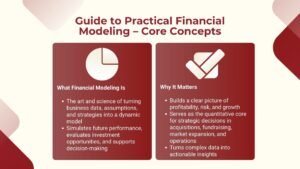
A financial modeling course with a certificate is a structured learning program that introduces students to financial modeling for forecasting, financial modeling for valuation, and financial modeling for business decision-making, and then officially certifies the competency by awarding a certificate. It includes conceptual learning along with exercises that use Excel to model real-world business scenarios, and helps students exit with real work-based artifacts, not just notes.

Certification is a mark of confidence that a learner is able to employ financial modelling techniques independently, rather than just learning the theory. This is particularly important when a candidate is being considered for an analytical position that needs to be filled immediately and for which there is no extensive training. 

Why Are Financial Modeling Skills Valuable in Today’s Finance Industry?

Financial modeling is useful because almost all the functions in finance—budgeting to investment analysis—rely on financial models to make decisions. Businesses require individuals who can turn business logic into real financial results in which the business leader can invest with surety.

The capacity to model, interpret, and stress test financial models has shifted from a niche technical specialty to a basic requirement, creating an even more competitive pool of trained professionals for finance, consulting, and start-up positions where crunching analysis is often needed in a hurry and with credibility. The capacity to build, interpret, and stress test financial models has evolved from a specialized technical skill to one that is expected of everyone in the business world, making trained professionals even more competitive in finance, consulting, and start-up roles where quick and credible analysis is often required. 

What Excel Skills Will You Learn?

Students will be taught advanced Excel skills such as lookup functions, nested formulas, dynamic charts, and structured model layouts that will be used to separate assumptions, calculations, and output. Such skills enable automatic updates of the model as changes occur in the input data, which can save a substantial amount of time over manually re-calculating the model.

When models are shared beyond the creator and need to be examined by others, courses also help with auditing the formulas, checking for errors, and formatting conventions that will make models easier to read by others. 

How Do Financial Modeling Courses Teach Financial Statement Analysis?

Courses introduce financial statement analysis by using them to introduce income statements, balance sheets, and cash flow statements as components of a comprehensive financial model. Learners learn to use the sense of trends, margins, and red flags of real company financials to understand their own company’s financials.

This analytical approach is put immediately into practice when building a model, requiring learners to be able to understand the meaning of statements accurately in order to make useful predictions about the future. 

How Are Financial Forecasts Built in Professional Models?

Financial forecasts are created by estimating revenue and expense drivers based on industry benchmarks, business assumptions and historical trends. Leaders practise how to work out forecasts of their revenues on a unit economics basis, based on unit pricing and rates of growth in revenues, as well as forecasting their expenses, which are linked to headcounts and increasing the scale of their operations, so that both sides of the forecast are internally consistent.

This is because investors and managers will test the reasoning behind each one of the numbers that come with credible forecasts before making decisions on the numbers; it is important that the assumptions are documented and defensible and not arbitrary growth estimates. 

How Do Learners Build Three-Statement Financial Models?

Learners create models of three statements, connecting the income statement, balance sheet and cash flow with changes in one automatically flowing through the others. This integration also provides consistency within each projected period and helps to identify errors that might be missed from a standalone statement.

In many financial modeling courses, the epitomic exercise is creating a three-statement model from scratch, as it is the ultimate exercise where the learner must integrate forecasting, accounting logic, and structuring in Excel all at once in one single exercise that mirrors the work of a pro in the real world. 

How Is Business Valuation Taught in Financial Modeling Courses?

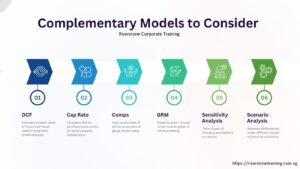
There are two main ways in which business valuation is taught: discounted cash flow (DCF) modeling and precedent transactions analysis. Discounted cash flow (DCF) modeling involves forecasting future free cash flows and discounting them to present value using a relevant discount rate. Comparable company analysis is also included as a supplemental valuation tool to complement courses and is based on market-observable data related to the company.

Learners learn to build a complete DCF model using forecasted financials, and the importance of the quality of the financial forecast as an important influence on the value calculation, not something that exists in isolation apart from the rest of the model. 

How Does Cash Flow Modeling Improve Financial Decision-Making?

Cash flow modeling helps decision-making by providing insights into when a business will have cash flowing in or out, which is essential for managing cash, investing, and avoiding cash shortages. This is particularly significant for those companies that do not experience consistent cash flow throughout the year and may not have obvious cash flow issues until they become critical.

Courses equip students with the skills to create monthly cash-flow statements that alert management of potential cash-flow issues before they worsen and become a major operational issue. 

How Are Scenario and Sensitivity Analyses Performed?

Scenario analysis is done by making toggle devices that can switch between sets of assumptions, e.g., best case, base case, worst case, and observing how the outcomes change. Sensitivity analysis in Excel Data Tables involves examining the effect of each variable separately and in combination on important results.

Learners apply both techniques to practice testing the impact of pricing, cost and growth changes on profitability and valuation, developing the analytical depth that investors and management ultimately demand before major decisions are made. 

How Can Financial Modeling Skills Help Startup Businesses?

Startups benefit from financial modeling skills because it allows the startup founders to make realistic projections for fundraising, plan the cash flow in the early days of the startup, and simulate various scenarios before investing resources. A good model takes on a new significance for investors and for planning within a company. Many training providers now offer a dedicated financial modeling for startups course to address these founder-specific needs directly.

Training entrepreneurs to create and modify their own financial models can also save costs and make decisions more quickly during rapid growth stages when time is a critical constraint and resources are scarce. 

What Practical Projects Are Included in Financial Modeling Training?

Practical projects usually consist of creating a full three-statement model, a DCF valuation, and a financial model of a startup from a blank workbook, making use of real-life company or business case data for the entire duration of the course (not simple textbook data).

A capstone project typically brings together forecasting, valuation, and scenario analysis into a single deliverable, and is often completed by the learners as a type of model they would be expected to create as an analyst in their first few months to a year on the job. 

How Does a Financial Modeling Course Prepare You for Real-World Finance Roles?

Courses are designed to enable learners to apply the concepts and tools they will use in the real world, not just abstract theory that is irrelevant to their duties. Courses are built to give learners the concepts and tools that they are going to use in the real world, not abstract theory that is irrelevant to what they do on the job.

Learners get ample opportunities to apply their new skills to realistic datasets and business scenarios to help them make a smooth transition to analyst, FP&A, or corporate finance roles where they will be expected to build and maintain models with minimal guidance from day one. 

How Does a Finance Modeling Course Certificate Support Career Growth?

A certificate contributes to career advancement by providing a credible indicator of hands-on modeling abilities, whether it’s for a job application or to help secure an elevation to a more analytical position. Professionals pursuing structured, career-focused training often consider options such as a financial modeling course with certificate to formalize and validate their skills.

The practical portfolio developed throughout the course also consists of completed models and case studies that the applicant can refer to in interviews and performance reviews and present themselves as an alternative to those who have only theoretical knowledge. 

What Industries Use Financial Modeling Skills?

Financial modeling skills apply to all aspects of investment banking, private equity, corporate finance, FP&A, consulting, real estate and startups—wherever forecasting and valuation decisions are needed to inform resource allocation.

Beyond the realm of traditional finance roles, operations, strategy, and business development teams are also increasingly using financial models to assess initiatives, defend budgets, and/or support cross-functional business cases being pitched to the leadership team. 

Why Is Continuous Financial Modeling Learning Important?

The need for continuous learning is crucial as business requirements, reporting expectations, and Excel tools keep changing over time, and time-static skills are slowly becoming obsolete compared to what employers expect from experienced personnel over time.

Experts who are ongoing practitioners and keep developing their expertise after the initial qualification are more capable of meeting the challenges of more complex forecasting, valuation, and scenario planning requirements as they progress in their careers, especially at senior analytical positions. 

Financial Modeling Skills You Will Gain

Skill Workplace Application
Financial Statement Analysis Business performance evaluation
Forecasting Budgeting and planning
DCF Valuation Investment analysis
Excel Modeling Financial decision-making

Common Financial Models Taught in Training

Model Purpose
Three-Statement Model Integrated financial forecasting
DCF Model Business valuation
Budget Model Financial planning
Scenario Model Risk assessment

Career Opportunities After Financial Modeling Training

Role Modeling Application
Financial Analyst Forecasting and reporting
FP&A Analyst Budgeting and planning
Investment Banking Analyst Valuation
Corporate Finance Professional Strategic decision-making

Startup Financial Modeling Applications

Startup Need Financial Modeling Benefit
Fundraising Investor-ready financial projections
Cash Flow Planning Liquidity management
Growth Forecasting Business expansion planning
Scenario Planning Strategic decision-making

Conclusion: Building Practical Financial Modeling Expertise

A financial modeling course with a certificate develops practical skills – financial statement analysis, financial forecasting, valuation, and financial modeling in Excel; helps to sharpen financial modeling analytical skills, which enables confident business decision-making for all business situations across all functional areas of finance.

Structured Training and Practical Projects prepare students for real-life financial analysis, and a financial modelling for start-ups course equips finance professionals and entrepreneurs with the ability to create powerful financial models for fundraising, growth planning, and investment decisions. The continuous learning of such skills through professional training and real-world application remains one of the most effective strategies to continuously enhance long-term career opportunities in finance, especially with the continued escalation of learner demand for analytical rigor. 
Frequently Asked Questions

What is a financial modeling course with a certificate?

Financial Modeling Course with Certificate is a structured, hands-on training that helps the students create financial models for forecasting, valuation and decision making and issues a certificate signifying that the learner has accomplished this competency by completing the exercises and projects.

They tend to acquire skills in financial statement analysis, revenue and expense forecasting, three-statement modelling, DCF valuation, scenario/sensitivity analysis and financial excel skills based on practical and real-life case studies instead of just theory, which will give them confidence to use these skills in the workplace independently.

Yes, financial modeling can be very helpful for startup founders, as it can help them project their business in a way that makes it more credible to raise funding, manage cash flow in a startup’s early stages, and test various scenarios before putting in limited resources.

Financial modeling is a key skill in various career paths such as financial analyst, FP&A analyst, investment banking analyst, corporate finance analyst, business consultant, and startup founder/operator, where they must make decisions without the assistance of other financial professionals.

Absolutely, a certificate can enhance career prospects by providing employers with tangible proof of hands-on skills and expertise, boosting job applications, aiding promotion discussions, and setting candidates apart in competitive positions within financial or analytical sectors.

Structured financial modeling courses with a certificate are typically available for students to take from a few weeks to a few months depending on the provider, the depth of study, and if the students are studying part-time or full-time along with other commitments.

Finance Modeling Course Certificate teaches students how to analyze financial statements, how to build a business model, how to build financial models in Excel, how to forecast, and how to value a business to show professional competency to employers. Learners also have practical experience using these skills in actual business and start-up situations. 

Finance Modeling Course Certificate

What Is a Financial Modeling Course with a Certificate?

A financial modeling course with a certificate is a structured learning program that introduces students to financial modeling for forecasting, financial modeling for valuation, and financial modeling for business decision-making, and then officially certifies the competency by awarding a certificate. It includes conceptual learning along with exercises that use Excel to model real-world business scenarios, and helps students exit with real work-based artifacts, not just notes.

Certification is a mark of confidence that a learner is able to employ financial modelling techniques independently, rather than just learning the theory. This is particularly important when a candidate is being considered for an analytical position that needs to be filled immediately and for which there is no extensive training. 

Why Are Financial Modeling Skills Valuable in Today’s Finance Industry?

Financial modeling is useful because almost all the functions in finance—budgeting to investment analysis—rely on financial models to make decisions. Businesses require individuals who can turn business logic into real financial results in which the business leader can invest with surety.

The capacity to model, interpret, and stress test financial models has shifted from a niche technical specialty to a basic requirement, creating an even more competitive pool of trained professionals for finance, consulting, and start-up positions where crunching analysis is often needed in a hurry and with credibility. The capacity to build, interpret, and stress test financial models has evolved from a specialized technical skill to one that is expected of everyone in the business world, making trained professionals even more competitive in finance, consulting, and start-up roles where quick and credible analysis is often required. 

What Excel Skills Will You Learn?

Students will be taught advanced Excel skills such as lookup functions, nested formulas, dynamic charts, and structured model layouts that will be used to separate assumptions, calculations, and output. Such skills enable automatic updates of the model as changes occur in the input data, which can save a substantial amount of time over manually re-calculating the model.

When models are shared beyond the creator and need to be examined by others, courses also help with auditing the formulas, checking for errors, and formatting conventions that will make models easier to read by others. 

How Do Financial Modeling Courses Teach Financial Statement Analysis?

Courses introduce financial statement analysis by using them to introduce income statements, balance sheets, and cash flow statements as components of a comprehensive financial model. Learners learn to use the sense of trends, margins, and red flags of real company financials to understand their own company’s financials.

This analytical approach is put immediately into practice when building a model, requiring learners to be able to understand the meaning of statements accurately in order to make useful predictions about the future. 

How Are Financial Forecasts Built in Professional Models?

Financial forecasts are created by estimating revenue and expense drivers based on industry benchmarks, business assumptions and historical trends. Leaders practise how to work out forecasts of their revenues on a unit economics basis, based on unit pricing and rates of growth in revenues, as well as forecasting their expenses, which are linked to headcounts and increasing the scale of their operations, so that both sides of the forecast are internally consistent.

This is because investors and managers will test the reasoning behind each one of the numbers that come with credible forecasts before making decisions on the numbers; it is important that the assumptions are documented and defensible and not arbitrary growth estimates. 

How Do Learners Build Three-Statement Financial Models?

Learners create models of three statements, connecting the income statement, balance sheet and cash flow with changes in one automatically flowing through the others. This integration also provides consistency within each projected period and helps to identify errors that might be missed from a standalone statement.

In many financial modeling courses, the epitomic exercise is creating a three-statement model from scratch, as it is the ultimate exercise where the learner must integrate forecasting, accounting logic, and structuring in Excel all at once in one single exercise that mirrors the work of a pro in the real world. 

How Is Business Valuation Taught in Financial Modeling Courses?

There are two main ways in which business valuation is taught: discounted cash flow (DCF) modeling and precedent transactions analysis. Discounted cash flow (DCF) modeling involves forecasting future free cash flows and discounting them to present value using a relevant discount rate. Comparable company analysis is also included as a supplemental valuation tool to complement courses and is based on market-observable data related to the company.

Learners learn to build a complete DCF model using forecasted financials, and the importance of the quality of the financial forecast as an important influence on the value calculation, not something that exists in isolation apart from the rest of the model. 

How Does Cash Flow Modeling Improve Financial Decision-Making?

Cash flow modeling helps decision-making by providing insights into when a business will have cash flowing in or out, which is essential for managing cash, investing, and avoiding cash shortages. This is particularly significant for those companies that do not experience consistent cash flow throughout the year and may not have obvious cash flow issues until they become critical.

Courses equip students with the skills to create monthly cash-flow statements that alert management of potential cash-flow issues before they worsen and become a major operational issue. 

How Are Scenario and Sensitivity Analyses Performed?

Scenario analysis is done by making toggle devices that can switch between sets of assumptions, e.g., best case, base case, worst case, and observing how the outcomes change. Sensitivity analysis in Excel Data Tables involves examining the effect of each variable separately and in combination on important results.

Learners apply both techniques to practice testing the impact of pricing, cost and growth changes on profitability and valuation, developing the analytical depth that investors and management ultimately demand before major decisions are made. 

How Can Financial Modeling Skills Help Startup Businesses?

Startups benefit from financial modeling skills because it allows the startup founders to make realistic projections for fundraising, plan the cash flow in the early days of the startup, and simulate various scenarios before investing resources. A good model takes on a new significance for investors and for planning within a company. Many training providers now offer a dedicated financial modeling for startups course to address these founder-specific needs directly.

Training entrepreneurs to create and modify their own financial models can also save costs and make decisions more quickly during rapid growth stages when time is a critical constraint and resources are scarce. 

What Practical Projects Are Included in Financial Modeling Training?

Practical projects usually consist of creating a full three-statement model, a DCF valuation, and a financial model of a startup from a blank workbook, making use of real-life company or business case data for the entire duration of the course (not simple textbook data).

A capstone project typically brings together forecasting, valuation, and scenario analysis into a single deliverable, and is often completed by the learners as a type of model they would be expected to create as an analyst in their first few months to a year on the job. 

How Does a Financial Modeling Course Prepare You for Real-World Finance Roles?

Courses are designed to enable learners to apply the concepts and tools they will use in the real world, not just abstract theory that is irrelevant to their duties. Courses are built to give learners the concepts and tools that they are going to use in the real world, not abstract theory that is irrelevant to what they do on the job.

Learners get ample opportunities to apply their new skills to realistic datasets and business scenarios to help them make a smooth transition to analyst, FP&A, or corporate finance roles where they will be expected to build and maintain models with minimal guidance from day one. 

How Does a Finance Modeling Course Certificate Support Career Growth?

A certificate contributes to career advancement by providing a credible indicator of hands-on modeling abilities, whether it’s for a job application or to help secure an elevation to a more analytical position. Professionals pursuing structured, career-focused training often consider options such as a financial modeling course with certificate to formalize and validate their skills.

The practical portfolio developed throughout the course also consists of completed models and case studies that the applicant can refer to in interviews and performance reviews and present themselves as an alternative to those who have only theoretical knowledge. 

What Industries Use Financial Modeling Skills?

Financial modeling skills apply to all aspects of investment banking, private equity, corporate finance, FP&A, consulting, real estate and startups—wherever forecasting and valuation decisions are needed to inform resource allocation.

Beyond the realm of traditional finance roles, operations, strategy, and business development teams are also increasingly using financial models to assess initiatives, defend budgets, and/or support cross-functional business cases being pitched to the leadership team. 

Why Is Continuous Financial Modeling Learning Important?

The need for continuous learning is crucial as business requirements, reporting expectations, and Excel tools keep changing over time, and time-static skills are slowly becoming obsolete compared to what employers expect from experienced personnel over time.

Experts who are ongoing practitioners and keep developing their expertise after the initial qualification are more capable of meeting the challenges of more complex forecasting, valuation, and scenario planning requirements as they progress in their careers, especially at senior analytical positions. 

Financial Modeling Skills You Will Gain

Skill Workplace Application
Financial Statement Analysis Business performance evaluation
Forecasting Budgeting and planning
DCF Valuation Investment analysis
Excel Modeling Financial decision-making

Common Financial Models Taught in Training

Model Purpose
Three-Statement Model Integrated financial forecasting
DCF Model Business valuation
Budget Model Financial planning
Scenario Model Risk assessment

Career Opportunities After Financial Modeling Training

Role Modeling Application
Financial Analyst Forecasting and reporting
FP&A Analyst Budgeting and planning
Investment Banking Analyst Valuation
Corporate Finance Professional Strategic decision-making

Startup Financial Modeling Applications

Startup Need Financial Modeling Benefit
Fundraising Investor-ready financial projections
Cash Flow Planning Liquidity management
Growth Forecasting Business expansion planning
Scenario Planning Strategic decision-making

Conclusion: Building Practical Financial Modeling Expertise

A financial modeling course with a certificate develops practical skills – financial statement analysis, financial forecasting, valuation, and financial modeling in Excel; helps to sharpen financial modeling analytical skills, which enables confident business decision-making for all business situations across all functional areas of finance.

Structured Training and Practical Projects prepare students for real-life financial analysis, and a financial modelling for start-ups course equips finance professionals and entrepreneurs with the ability to create powerful financial models for fundraising, growth planning, and investment decisions. The continuous learning of such skills through professional training and real-world application remains one of the most effective strategies to continuously enhance long-term career opportunities in finance, especially with the continued escalation of learner demand for analytical rigor. 
Frequently Asked Questions

What is a financial modeling course with a certificate?

Financial Modeling Course with Certificate is a structured, hands-on training that helps the students create financial models for forecasting, valuation and decision making and issues a certificate signifying that the learner has accomplished this competency by completing the exercises and projects.

They tend to acquire skills in financial statement analysis, revenue and expense forecasting, three-statement modelling, DCF valuation, scenario/sensitivity analysis and financial excel skills based on practical and real-life case studies instead of just theory, which will give them confidence to use these skills in the workplace independently.

Yes, financial modeling can be very helpful for startup founders, as it can help them project their business in a way that makes it more credible to raise funding, manage cash flow in a startup’s early stages, and test various scenarios before putting in limited resources.

Financial modeling is a key skill in various career paths such as financial analyst, FP&A analyst, investment banking analyst, corporate finance analyst, business consultant, and startup founder/operator, where they must make decisions without the assistance of other financial professionals.

Absolutely, a certificate can enhance career prospects by providing employers with tangible proof of hands-on skills and expertise, boosting job applications, aiding promotion discussions, and setting candidates apart in competitive positions within financial or analytical sectors.

Structured financial modeling courses with a certificate are typically available for students to take from a few weeks to a few months depending on the provider, the depth of study, and if the students are studying part-time or full-time along with other commitments.

Related Posts

Everything You Need to Know About Financial Modeling Courses

Contact Riverstone Training today to boost your skills and advance your career.