A business plan is a document that describes the nature of a business, how it will compete, and how it will grow. A financial model is a way of expressing those intentions in numbers. This comparison sets out the financial model and business plan distinction for founders, entrepreneurs, investors, and finance professionals deciding which document they actually need.

What Is a Financial Model?
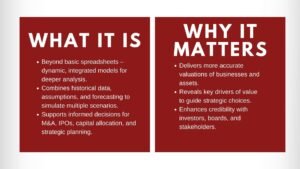
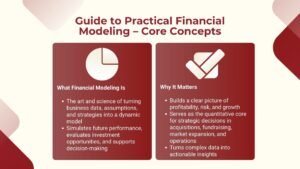
A financial model is a model generated by a spreadsheet that represents a company’s projected financial performance. It sets a series of assumptions to expected results that allow a founder, analyst or investor to visualize the performance of the business over time and the effect of the various assumptions.
A well-built model typically covers:
- Revenue projections
- Cost assumptions
- Profit forecasts
- Cash flow
- Working capital
- Capital expenditure
- Financing and debt
- Taxes
- Balance sheet
- Valuation
- Scenarios and sensitivity analysis
The key characteristic of a financial model is its dynamism. With a single change of an assumption, such as a growth rate, a price point, a hiring date, a user can immediately visualize how this change cascades through the revenue, cost, cash, and funding requirements. This is what makes a model different from a static forecast: it’s a tool to test a decision, not record a decision.
Take an example of a simple. A startup has 1,000 customers, an average annual revenue per customer of $100, an annual increase of one-fifth of customers, and a gross margin of 60%. These are mere guesses if left to themselves. A financial model converts them into a forecast of revenues, gross profit, operating costs, monthly cash flow and the investment needed to reach breakeven. So if you want to change the growth rate by 10% or the margin to 45%, the model will show you exactly how the funding requirement changes.
This is why a financial model for startups is less a spreadsheet exercise and more a decision-making tool. Early-stage businesses do not usually have enough data to make any kind of prediction, so the model is about pushing the numbers to the limits before investing and never about coming up with one ‘right’ answer.
What Is a Business Plan?
A business plan is a wider strategic and operational document that provides a description of how the business will operate, compete and grow. A business plan is a narrative, as opposed to a financial model, in which the numbers are explained, not presented.
Typical components include:
- Business overview
- Products and services
- Target market and customer segments
- Competitive landscape
- Marketing and sales strategy
- Operations
- Management team
- Business model
- Growth strategy
- Risks
- Financial overview
All business plans do not have to be exactly the same and the degree of detail will largely be dependent on the audience. The document for an internal plan is not the same as a document that would be created for a bank or institutional investor. The document itself is always the same thing: it sets the strategic and operational framework and the financial model is what will validate the strategic & operational framework financially.
Financial Model vs Business Plan: What Is the Difference?
At the centre of the difference between financial model and business plan comparison is a simple distinction. Business plans outline a business’s purpose and mission. A financial model verifies if the assumptions made in that intention can lead to a financially viable outcome.
| Factor | Financial Model | Business Plan |
| Purpose | Quantitative | Strategic / narrative |
| Revenue | Detailed projections | High-level |
| Cash Flow | Detailed | Usually summarised |
| Scenarios | Yes | Limited |
| Investor Use | High | High |
| Operational Planning | Moderate | High |
| Assumptions | Detailed and dynamic | Usually explained narratively |
| Financial Statements | Integrated projections | Usually summarised |
| Sensitivity Analysis | Common | Limited |
| Funding Requirements | Detailed | Summarised |
| Valuation Analysis | Can be included | Usually limited |
| Update Frequency | Can be frequently updated | Updated when strategy changes |
The financial model is detailed and the mechanics are in the financial model, while the business plan has the reasoning and the context. Neither takes the place of the other. A model that has no plan is a set of numbers and a plan that has no model is a set of intentions and no financial proof that they will work.
How Do a Financial Model and Business Plan Differ in Purpose?
Business Plan
The business plan answers questions such as:
- What problem does the company solve?
- Who are the customers?
- What is the market?
- How will the company compete?
- How will the company acquire customers?
- How will the company operate?
- What is the growth strategy?
Financial Model
The financial model answers a different set of questions:
- How much revenue can the company generate?
- What will it cost to operate?
- When will the company become profitable?
- How much cash will it consume?
- How much funding is required?
- What happens if growth is slower than expected?
- What happens if costs increase?
- What valuation might the business support?
Even when both documents are prepared for the same company, they are doing fundamentally different jobs. One explains the business; the other tests it.
Which One Do Investors Need?
Both can be used by the investors depending upon the stage and context of the investment. It is not a rule that every investor wants to invest in a business that has a business plan around it. Requirements differ based on investor type, funding stage, industry, transaction size and business maturity.
Business Plan Provides
- Strategic narrative
- Market opportunity
- Business model
- Competitive positioning
- Management strategy
- Growth plan
Financial Model Provides
- Financial assumptions
- Revenue forecast
- Cost structure
- Cash requirements
- Funding requirements
- Projected profitability
- Scenario analysis
- Potential returns
Sophisticated investors, especially those considering larger or later stage deals, are more likely to want to see if the business plan assumptions are realistic and can be supported by realistic projections. A good story without any monetary proof is more a question than an answer.
Do Startups Need Both?
It’s important for many startups to have a strategic business plan and financial model, but the degree of detail varies according to the stage of the startup.
Pre-Revenue Startup
- Business model assumptions
- Customer acquisition
- Pricing
- Operating costs
- Runway
- Funding requirements
Early-Revenue Startup
- Actual revenue data
- Customer growth
- Retention
- Gross margin
- Unit economics
- Cash conversion
Growth-Stage Startup
- Detailed departmental forecasts
- Hiring plans
- Working capital
- Capital expenditure
- Financing
- Scenario analysis
- Valuation considerations
A financial model for startups becomes increasingly useful as the business accumulates operating data and faces more complex funding and growth decisions. A pre-revenue company is largely testing assumptions; a growth-stage company is using the model to make real allocation decisions about hiring, capital, and expansion timing.
When Should You Build a Financial Model?
Businesses commonly build or update a financial model when:
- Launching a business
- Preparing to raise capital
- Applying for financing
- Launching a new product
- Entering a new market
- Planning hiring
- Evaluating pricing
- Preparing annual budgets
- Forecasting cash flow
- Considering an acquisition
- Preparing for an exit
A financial model should not be a one-off fundraising document created and left on the shelf. It’s best used as an ongoing process of deciding and revising as results emerge and new decisions are made that require testing.
When Should You Write a Business Plan?
A business plan tends to be most useful when:
- Starting a new business
- Defining the operating model
- Entering a new market
- Communicating strategy
- Preparing for external funding
- Aligning management
- Developing a growth strategy
- Applying for certain types of financing
The degree of detail should be appropriate to the intent. An internal business plan for strategic planning does not have to be as formal or as well put together as an external plan that will be presented to the bank or to investors.
How Does a Financial Model Support a Business Plan?
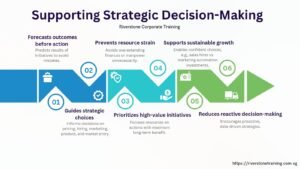
The two are not competing documents but rather they go hand-in-hand and flow naturally into each other: first there’s a business strategy, then a business plan, which sets financial assumptions, which feeds a financial model, which feeds in scenario analysis, which feeds in and informs decision-making.
Example 1: Revenue Growth
Business plan: “The company will expand into a second market.”
Financial model: The number of customers, price, customers acquisition cost, the launch cost, hiring, revenue ramp up and expected margins.
Example 2: Hiring
Business plan: “The company will expand the sales team.”
Financial model: hires, salary, recruitment cost, sales per hire, when will the sales be realized, cash-flow impact.
Example 3: New Product
Business plan: “The company will launch a premium product.”
Financial model: development cost, pricing, volume, gross margin, marketing expense and break-even point.
In every instance, it’s a model that will determine whether the business plan strategy can be financially viable — and if it’s not, the numbers reveal this long before the business reveals it.
How Does Business Financial Planning Connect the Two?
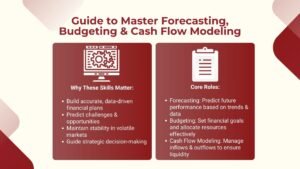
Business financial planning is the ongoing process that connects strategy with financial resources and expected outcomes. It encompasses the concepts of budgeting, forecasting, cash planning, capital allocation, scenario planning, investment decisions and capital targets.
A useful way to hold the three concepts together is as a three-part framework:
- Business plan — strategic direction
- Financial model — quantitative engine
- Business financial planning — ongoing financial decision-making
The business plan is a direction setting document, which is updated only if strategy changes. The financial model is a representation of that direction in numbers and can be recreated based on new assumptions as needed. Business financial planning has been an ongoing process that depends on comparing actual outcomes to forecasts, making budget changes and incorporating new decisions into the model.
What Happens If the Financial Model and Business Plan Do Not Match?
There are lots of inconsistencies between the two documents, inconsistencies that are useful — they may expose the weakness in the underlying assumptions before they become problems in operation.
Business Plan Says High Growth, Model Shows Low Cash
The plan may be based on a growth pattern that is more aggressive than what has been funded.
Business Plan Assumes Strong Margins, Model Shows High Costs
The underlying cost assumptions need to be investigated before the margin claim can be trusted.
Business Plan Assumes Rapid Hiring, Model Shows Cash Constraints
The company may have to alter its hiring schedules or raise more capital to implement the plan as it is.
Business Plan Targets Expansion, Model Shows Negative Returns
Management might have to reflect on the timing and/or economics of the expansion – not just on the narrative.
Common Mistakes When Preparing Both
Treating the Business Plan as a Sales Document Only
Realistic assumptions are required to back up strategic claims, rather than just for persuading.
Building a Financial Model With Unrealistic Assumptions
Weak assumptions are not going to be believed by a sophisticated spreadsheet, the model is only as good as what goes into it.
Creating the Documents Separately
The business plan and financial model should be “told in the same way” and not created by various individuals at various times.
Using Overly Optimistic Growth Rates
But scenario analysis actually exists so that it can go against this tendency; it demonstrates what occurs under more conservative assumptions.
Ignoring Cash Flow
Profitability is not synonymous with liquidity and cash shortages can happen in a profitable business.
Failing to Update the Model
Performance should be reviewed against projections on a regular basis and not after the initial build.
Making the Model Too Complex
A model should be detailed enough to be useful for the decision being pursued, but understandable and maintainable by those who will be using it.
Treating the Business Plan as Permanent
Business plans are not static, they are a living document that adapts to changing markets, customers, competitors or changing strategy.
Which Is More Important: a Financial Model or a Business Plan?
There isn’t a right or wrong answer — it will vary with the decision you’re making.
| Situation | More Important |
| Explaining business strategy | Business Plan |
| Testing financial viability | Financial Model |
| Fundraising | Usually Both |
| Cash-flow planning | Financial Model |
| Market positioning | Business Plan |
| Scenario analysis | Financial Model |
| Operational planning | Business Plan |
| Funding requirement analysis | Financial Model |
| Communicating overall strategy | Business Plan |
In most real decisions, founders realize that they will have to refer to both documents rather than only one.
Conclusion
Financial model vs business plan does not mean the choice between two contrasting papers. Business plan is a story and a strategy. Business financial planning is the ongoing discipline that connects the two — using both to test assumptions, communicate strategy, plan funding, and make better financial decisions.
Those who wish to enhance these skills may combine both by enrolling in a financial modelling course, or receive specialized assistance for the enterprise’s business financial modelling.