
A financial modelling case study enhances practical skills as the student will need to use financial concepts in realistic business situations, thereby providing the student with improvement in his/her ability to model in Excel, prediction accuracy, and financial decision-making. A practical approach to get from theory to confident modelling in the workplace.
What Is a Financial Modelling Case Study?
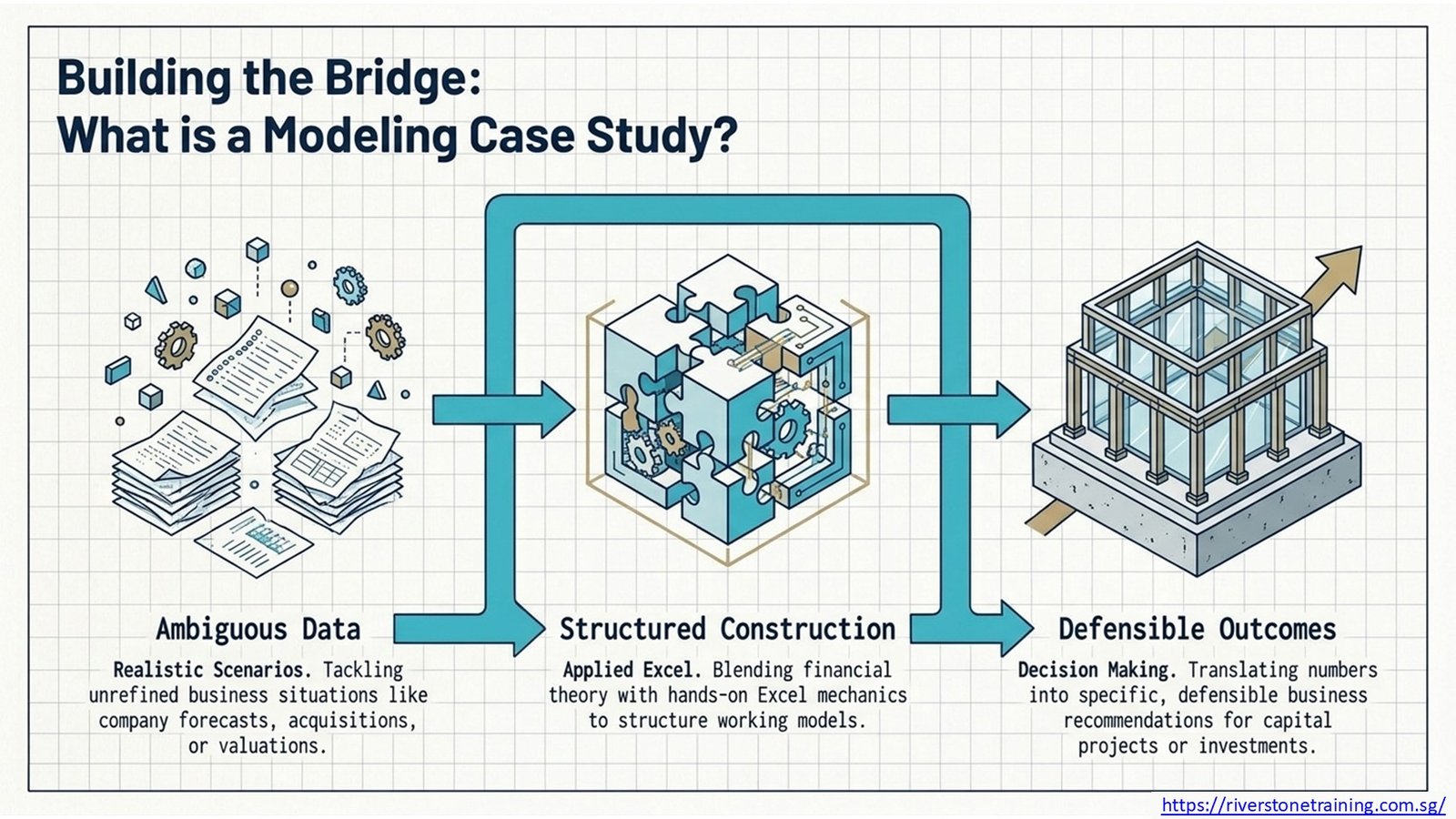
A financial modelling case study is a structured exercise that asks students to create a working financial model based on a realistic business scenario, e.g., a company forecast, acquisition, or company valuation. It is a blend of theory and practical construction of models with actual or realistic data.
As in real life, a case study will involve making assumptions, determining a structure, and interpreting it to the reader, all of which the learner has to make.A case study will involve the learner in making assumptions, determining a structure and interpreting it to the reader, as in real life. In the case of a learner developing a startup revenue forecast, for instance, they have to work out how to deal with uncertain growth rates, instead of just blindly copying a formula.
Why Are Case Studies Important in Financial Modelling Courses?
Case Studies are significant as they enable students to try out the models without merely seeing them in a lecture. This type of practical competence is crucial in financial modelling for finance professionals, as the problems they typically encounter in the real world are rarely well-defined and well-structured.
Additionally, tackling a full case study also uncovers an understanding gap that multiple-choice testing could not have identified. Theory of operating and financing cash flows is one thing; modelling the correct operating and financing cash flows is another.
How Do Case Studies Improve Excel Modelling Skills?
Case studies enhance Excel modelling ability by asking the learner to create formulas, organise worksheets, and connect the calculations between several tabs in a real scenario. This repetition cannot be reproduced by isolated formula tutorials to build speed and accuracy.
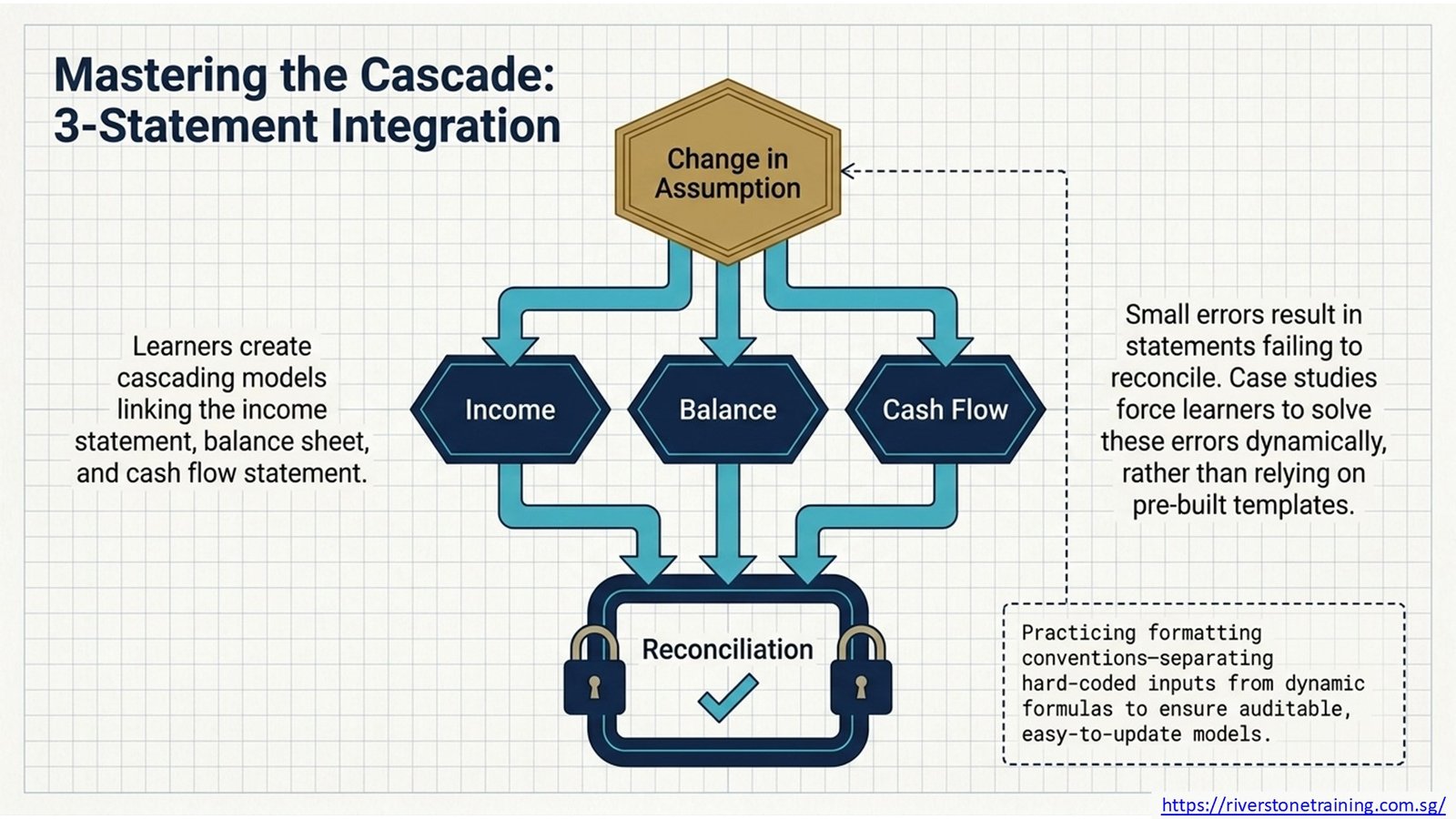
Learners also have the opportunity to practice key technical habits like formatting inputs differently from formatting formulas and not using hard-coded numbers in the calculations. A model developed with assumptions in code, for example, can be hard to update; this is a typical problem that can be fixed earlier in the process of a case study.
Case study work typically develops the following core modelling skills:
| Skill | Practical Benefit |
| Forecasting | Improves planning accuracy |
| Excel Modeling | Builds dynamic, reusable financial models |
| Scenario Analysis | Evaluates business uncertainty |
| Valuation | Supports investment decisions |
How Do Learners Build Integrated Financial Models?
Learners create “cascading” financial models linking the income statement, balance sheet, and cash flow statement together so that a change in one assumption is reflected correctly in each of the three. One of the most difficult skills to master in a case study is this one.
Multiple scenarios that balance the three statements correctly show actual modelling competency, as small model errors can result in the three statements not reconciling. The learner is forced to solve these errors by using case studies, and not a template they have built beforehand.
Most financial models share the following core components:
| Component | Purpose |
| Income Statement | Measures profitability |
| Balance Sheet | Evaluates financial position |
| Cash Flow Statement | Tracks liquidity |
| Assumptions Sheet | Drives model calculations |
How Do Case Studies Improve Financial Forecasting?
Case studies help students as they learn to forecast the finances for a project by allowing them to make assumptions and then see how well their chances of success fare with varying circumstances. This is more instructive than looking at a completed forecast by another person.
For example, in a budgeting case study, a learner may need to predict departmental costs based on historical trends and then factor in a departmental expansion. Using this process helps develop a better understanding of the impacts of assumption selections on the reliability of forecasts.
Why Is Scenario and Sensitivity Analysis Important?
Business outcomes often do not proceed in a linear path, and decision makers need to understand how a model reacts to varying conditions; that is, scenario and sensitivity analysis is important. This skill is developed in case studies where students are asked to test the best case, worst case, and base case situations in the case.
Sensitivity analysis takes it one step further by identifying which specific assumptions are most influential on the outcomes of an analysis, for example, a discount rate for a valuation model. By finding a model whose output is very sensitive to one or a few of its inputs, a learner has learned something that a static forecast wouldn’t have shown.
How Do Case Studies Strengthen Business Decision-Making?
The use of case studies reinforces decision-making by making the learner take the decisions shown in the models and convert them into a specific business recommendation, rather than just showing numbers. This reflects the actual expectation that is put on a finance professional, and the analysis that they perform must be able to help in a decision-making process.
One exercise that might be given to a learner in an investment analysis case study could be to advise a business on whether or not to undertake a capital project based on expected costs and expected risks. Protecting that endorsement builds confidence right into the workplace credibility.
How Are Valuation Models Applied in Practice?
The valuation models are put into practice by valuing a company from various aspects, for instance through discounted cash flow analysis, in which case students are asked to construct and substantiate, with particular business assumptions, a valuation model. This links theory with some tangible and defensible product.
Learners are normally asked to make future cash flow projections, determine a discount rate and compute a terminal value, and then compare that terminal value to the market in a DCF valuation case study. The process of going through these steps develops the same judgment required to be able to value a business in a credible fashion, rather than simply arriving at a formula correct.
What Common Modelling Mistakes Do Learners Discover?
Errors are often found in learners’ worksheets, including circular references, imbalanced balance sheets and formulas that fail when assumptions change. These errors are hard to predict in theory but may be revealed as a model is tested under different inputs.
Case studies also reveal the danger of getting the growth rates into the forecast right, for example, making the assumption that growth will be higher than it actually is, which makes the forecast look appealing but turns out to be unachievable. It is much cheaper to identify these things in training as opposed to after a decision is made based on a model.
How Do Case Studies Prepare Professionals for Real Projects?
Case studies simulate the ambiguity, time constraints, and lack of information that are common to real finance cases, and are designed to prepare professionals for real projects. Strengthening financial modelling for finance professionals through this kind of applied practice builds confidence that transfers directly to on-the-job modelling tasks.
A learner who has had a complete acquisition model under training conditions will be much better equipped to work on a real M&A project than a learner who has only studied acquisition theory. Case studies bridge the divide between theory and practice.
Which Industries Use Financial Modelling Case Studies?
Case studies on financial modelling are critical components of the training and hiring of investment bankers, private equity firms, corporate finance, FP&A and accounting advisory firms. That’s why these types of interviews are often conducted with modelling tests.
Case-study-based modelling is also a common approach for budgeting and capital planning in manufacturing and retail finance teams, even when not in a deal-focused environment. However, the underlying modelling discipline remains the same for each setting, despite the variations in the business context.
Common case study types and the primary skill each one builds are outlined below:
| Case Study | Primary Learning Outcome |
| Startup Forecast | Revenue projection |
| DCF Valuation | Investment valuation |
| M&A Analysis | Acquisition evaluation |
| Budget Planning | Financial planning |
How Does Feedback Improve Financial Modelling Skills?
Feedback helps a learner to recognise structural errors, weak assumptions or poor presentation of financial modelling, which they might not have identified without the support of feedback. A completed case study is then used as a real learning experience through instructor review.
Detailed feedback on formula structure, assumption logic and output interpretation assists learners to address habits in time before they become professional work habits. If a learner is told that their model does not have a clear tab for assumptions, for instance, they can easily make that adjustment for future models.
How Do Financial Modelling Certifications Demonstrate Practical Competence?
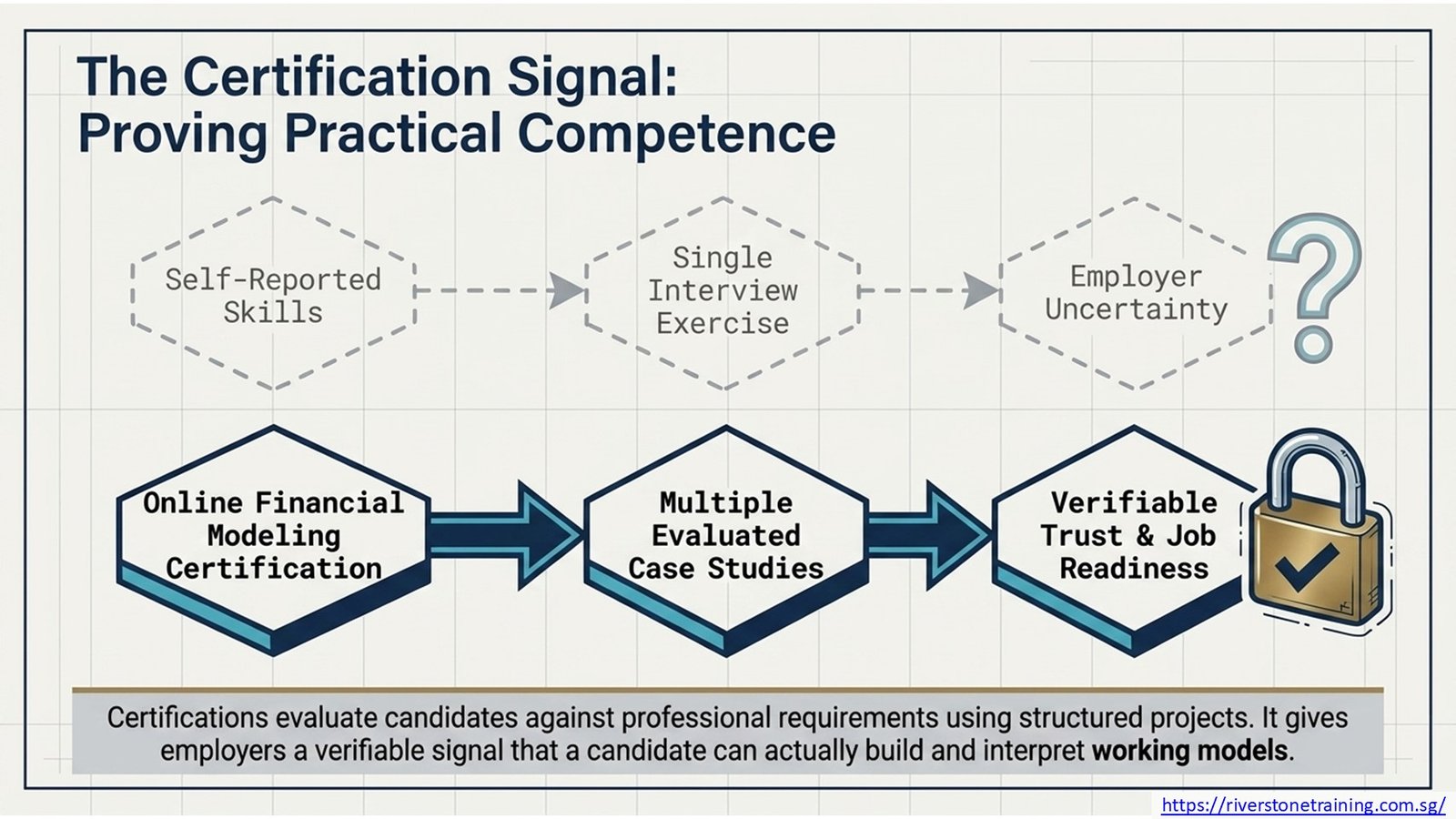
Financial modelling certifications are practical in nature, requiring students to work through a structured project and case studies that are evaluated against professional requirements, as opposed to relying on self-reporting. A financial modelling certification online gives employers a verifiable signal that a candidate can actually build and interpret working models.
Certification programs are usually based on several case studies completed, which will give a more comprehensive proof of skill than a single interview exercise. This is especially useful for roles that involve a strong modelling component and are adjacent functions in finance.
Why Is Hands-On Practice More Effective Than Theory Alone?
Unlike a lot of theory, hands-on practice is superior because financial modelling is a constructive skill just like writing code – understanding the concepts does not mean the skill will be mastered during a crisis. Fluency is built by repeatedly building models.
It is difficult for practitioners who learn only the concepts of modelling to create a model when required to start with a blank worksheet, because in real modelling, one has to structure an approach before he or she uses any formula. This structuring step is required every time with case learning and is not required with theory-only learning.
How Can Professionals Continue Improving Their Modelling Skills?
Practitioners can further develop modelling skills by solving new case studies regularly, by receiving feedback on their created models and by using modelling techniques on actual projects, if available. It is common for the skill to fade when modelling is not consistently done.
Examining the models created by others, like experienced analysts, and how they organise assumptions and error checking will also help to speed up improvement. Valuation, FP&A, and corporate finance are just a few of the careers that are more likely to be the next steps for professionals who think modelling is more than a course outcome.
Financial modelling skills apply across a range of finance career paths:
| Role | Modeling Application |
| Financial Analyst | Forecasting and reporting |
| Investment Banker | Company valuation |
| FP&A Analyst | Budgeting and planning |
| Corporate Finance Manager | Strategic decision-making |
The summary below brings together the core practical skills financial modelling case studies build:
| Skill Area | Why It Matters |
| Excel Modeling | Builds technical accuracy and speed |
| Integrated Statements | Ensures models reconcile correctly |
| Forecasting | Supports realistic business planning |
| Scenario Analysis | Tests decisions under uncertainty |
| Valuation | Converts analysis into investment recommendations |
Conclusion
Through a financial modelling case study, learners are able to apply the principles of financial theory to develop a working financial model around a realistic scenario, test the model and make adjustments to the model. This practical process is much more effective in improving forecasting, valuing and financial analysis than theory alone.
Financial modelling for finance professionals builds on the advanced technical skills required for corporate finance, FP&A, and investment banking, and a financial modelling certification online showcases these skills through real-world, structured projects. Regardless of whether this is a financial modelling job or a regular career in finance, anyone who keeps going with practice, real-world finance cases and structured training will be more ready to meet the analytical requirements of any career in finance.