The three-statement financial modeling enhances financial forecasts by incorporating profitability, financial position and cash movements into one consistent financial model. An integrated model illustrates how one assumption (such as a shift in revenue growth or collection terms) passes through the income statement, the balance sheet and cash flow statement at the same time. This article details how this integration works in practice and how finance professionals utilize it for forecasting, scenario analysis and decision making.
What Is Three-Statement Financial Modeling?
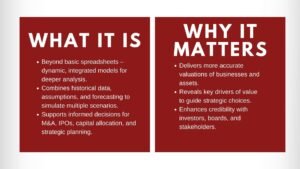
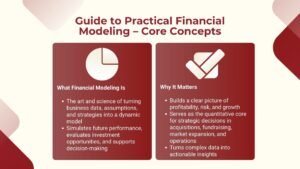
Three-statement financial modeling is the art of creating a cash flow statement, balance sheet and income statement that is mathematically connected, meaning that if you change one of the assumptions, it changes the other two as well. The model is not designed to predict each of the statements separately, but rather to make predictions about the statements as a whole, using a set of operating assumptions, investing assumptions, and financing assumptions. This structure is similar to the way a real business works because decisions to generate revenue are never made without being related to spending decisions or financing decisions.
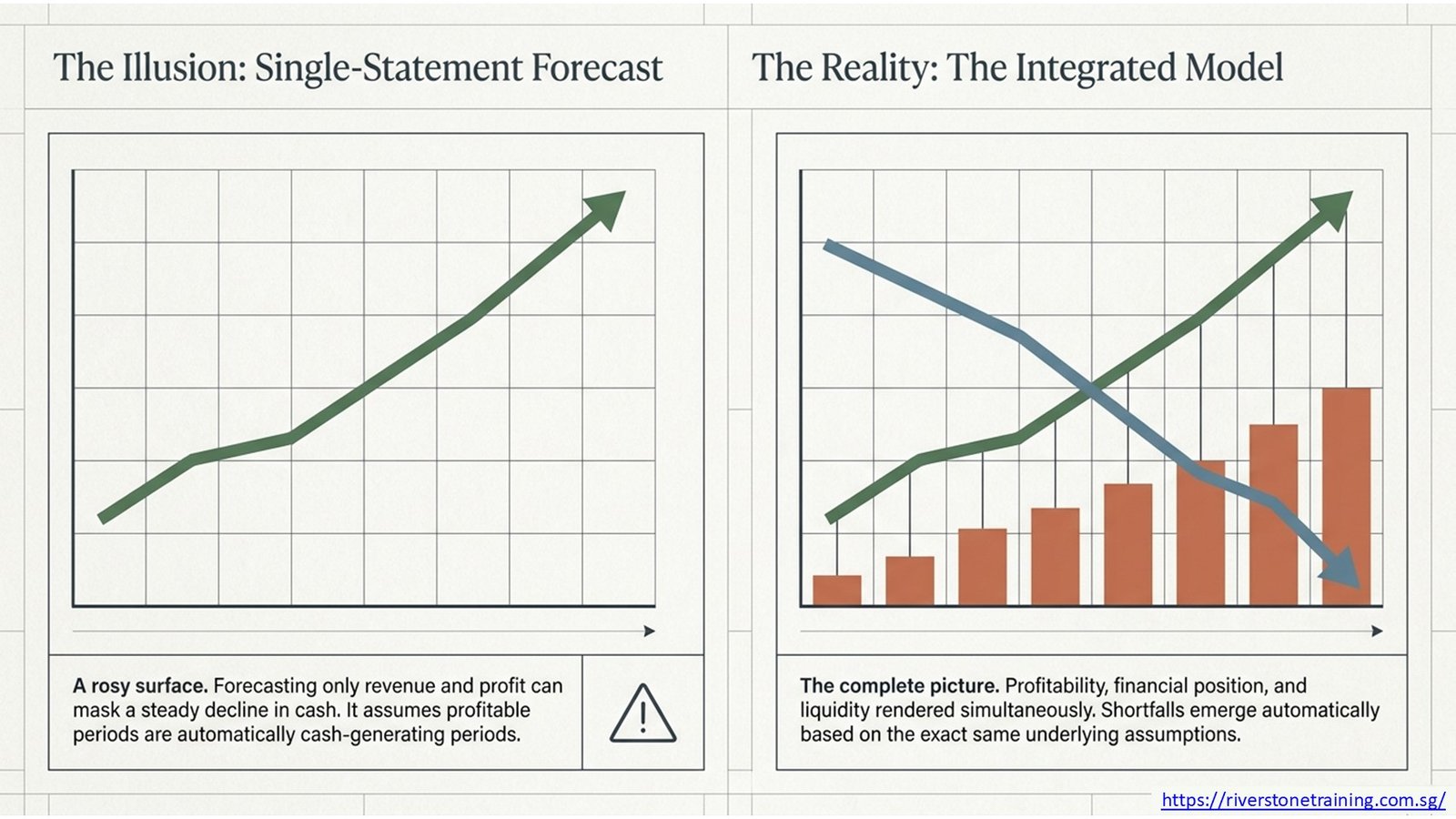
Not the same as a revenue or profit prediction, which only projects future income, but not the impact on the balance sheet or cash. Much more useful, a three-statement model simultaneously renders a complete picture of profitability, financial position, and liquidity, and is the preferred modeling method in FP&A, corporate finance, and investment analysis.
| Statement | Primary Purpose | Key Forecast Items |
| Income Statement | Measures profitability | Revenue, expenses, EBITDA, net income |
| Balance Sheet | Shows financial position | Assets, liabilities, equity |
| Cash Flow Statement | Tracks cash movement | Operating, investing, financing cash flow |
How Do the Three Financial Statements Connect?
The income statement measures profitability while the balance sheet provides an overview of financial position at a particular point of time and the cash flow statement provides a picture of actual cash flow during the period. Net income from the income statement would appear in the retained earnings on the balance sheet, and would also be the beginning of the cash flow statement in an integrated model. Then, the depreciation, working capital adjustments and other non-cash adjustments reconcile net income with actual operating cash flow.
Capital expenditure affect cash and fixed assets in the balance sheet, while debt issuance or repayment affects the cash-and-liabilities portion of the balance sheet and the financing cash flow. The cash balance at the bottom of the cash flow statement then goes to the cash line on the balance sheet, which is how the balance sheet balances. It is this closed loop that makes a difference between three-statement modeling and three unrelated spreadsheets.
Why Does Linking the Statements Improve Forecast Accuracy?
The combination of statements enhances the predictiveness of the forecast, forcing all the assumptions to be seen in their complete financial impact on the forecast, not just as it relates to one statement. An annual forecast that only shows revenue and profit can appear rosy on the surface if it masks a steady decline in cash because they are relying on their customers to slow down their payments or they are spending a lot of money on capital purchases. That shortfall emerges automatically in an integrated model, since operating cash flow and ending cash are based on the same assumptions that underlie profitability.
This also ensures internal consistency checks are performed and helps identify modeling errors early on. Also, if the balance sheet is not balanced, it typically indicates that an assumption was used in one statement but not in the others, and this is something that isolated, single-statement forecasts can’t enforce.
How Do Revenue Assumptions Flow Through the Model?
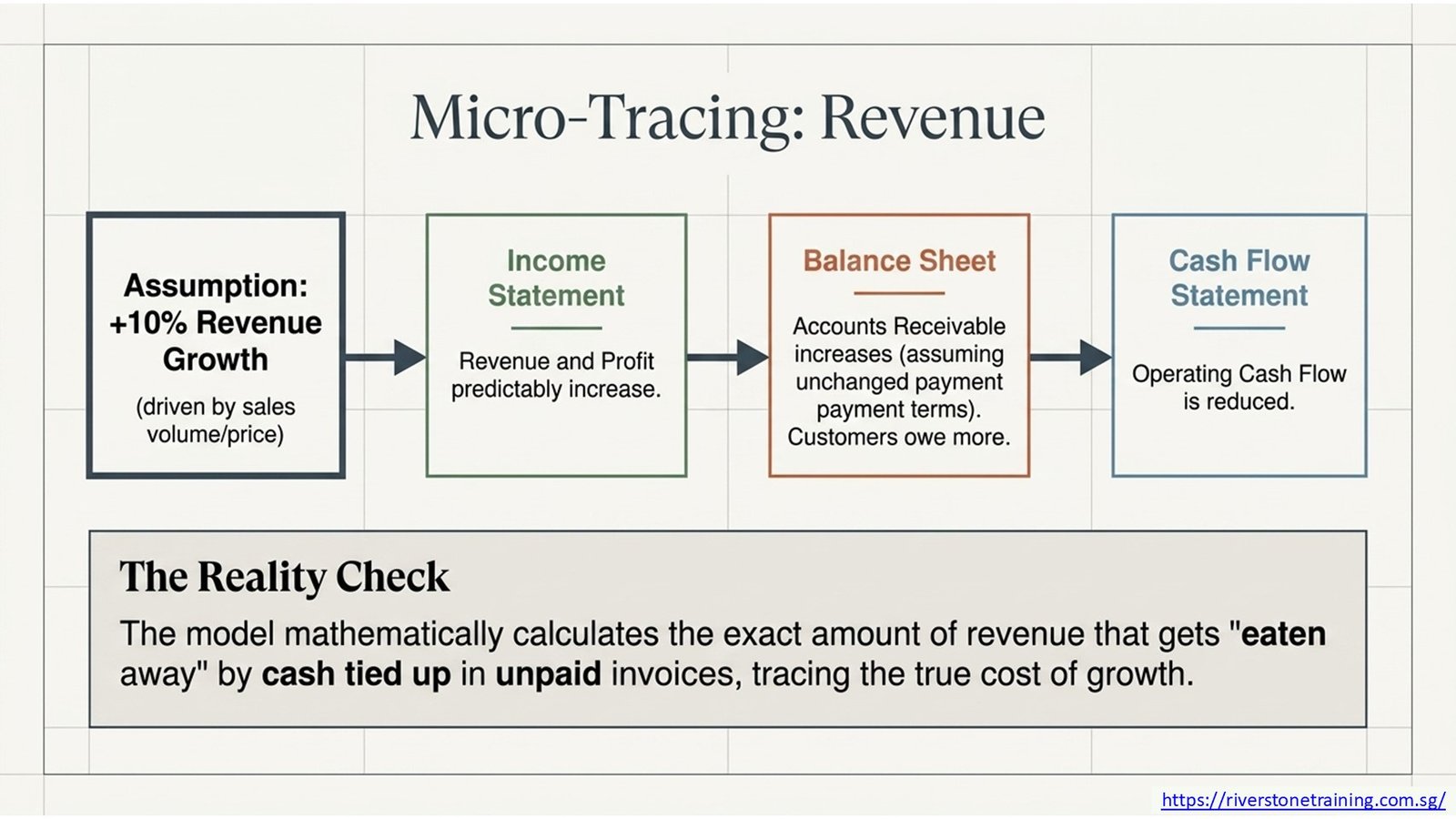
Revenue assumptions are generally constructed by factors other than just a top-line growth rate, including sales volume, average selling price, customer growth, and market growth, among other variables. After revenue is predicted on the income statement, the same assumption is applied to the accounts receivable on the balance sheet—because revenue tends to increase, so does the amount that is owed by customers. The remainder of the receivable balance will impact working capital, and this will impact the operating cash flow on the statement of cash flow.
For instance, if a company expects to grow 10% in revenues, its income statement will reflect the growth, its balance sheet will show an increase in accounts receivable if no changes in payment terms, and some of that revenue will be eaten away by the cash that will be tied up in invoices that have not yet been paid. This is a way to trace revenue across all three statements to see the true cash impact of growth and not just the impact on reported profit.
How Do Expense Assumptions Affect All Three Statements?
Expense assumptions such as cost of goods sold, employee expenses, rent, marketing expenses, administrative expenses, depreciation and interest expense all directly impact profitability on the income statement and each have their own impact somewhere else in the model. The cost of goods sold that relates to inventory purchases will affect the inventory and accounts payable balance sheet accounts, while depreciation will not involve any cash, therefore it is added back on the cash flow statement.
Interest expense is the link between the income statement and the debt schedule because the amount of interest expense is derived from the debt outstanding on the balance sheet. An accurate representation of these links should clearly show changes in profitability, the related balance sheet account and cash flow as they change, not just in the model.
How Does Working Capital Affect Financial Forecasts?
One of the more obvious reasons why revenue growth and cash generation are not synonymous is because working capital, which consists of the accounts receivable, accounts payable and inventories of a business, dictate how much cash a business needs to run its daily operations. High revenue growth does not necessarily equal high cash flow – when revenues go up a lot, but customers pay later, AR goes up and cash goes out, not in.
Three statement modeling provides a much better picture of this relationship than forecasting the income statement, since any changes in working capital are computed directly from the balance sheet and directly into operating cash flow. This allows the finance professionals to clearly visualize cash conversion, and not presume that a profitable period is automatically a cash-generating period.
How Does Capital Expenditure Affect the Three Statements?
Capital expenditure is a money investment in a long-lived asset, like equipment, property or technology, and has an impact on all 3 statements. In the cash flow statement, capex is shown as an investing outflow in the immediate time period and in the balance sheet, capex adds to fixed assets, not the expense.
The effect of the income statement is only felt over time, via depreciation expenses that are booked as they are incurred (which are deducted from future profit and added back on the cash flow statement as a non-cash item). Reported profit will be a smaller depreciation charge every period, but modeling capex this way will mean the company’s forecasted cash position will be equal to the total upfront cost of growth.
How Are Debt and Interest Expense Integrated Into the Model?
Debt is usually represented by a cycle or series of balances, starting with the balance to be expected at the beginning of the forecast period, additions, deductions, and the balance at the end of the forecast period. That closing balance directly goes into the liabilities on the balance sheet, new debt or repayments are listed as financing activities on the cash flow statement, and interest charged on the closing balance goes into interest expense on the income statement.
In more complex models, there is a circular effect because interest expense is a component of net income and cash flow, which in turn can determine the amount of debt or cash available in subsequent periods. Creating the debt schedule as its own linked component instead of hard-coding in the interest expense makes the financing assumptions consistent with the remainder of the model.
How Does the Cash Flow Statement Connect Profitability and Liquidity?
The cash flow statement represents the link between accounting profits and cash flow, and it accounts for net income, adjustments to operating cash flow, investing cash flow and financing cash flow to arrive at the ending cash balance. Operating cash flow adjusts net income for non-cash items (such as depreciation) and for the working capital flows; investing cash flow reflects capital expenditure and asset activity (purchases or sales); and financing cash flow reflects debt and equity activity.
A dedicated financial modeling cash flow forecast complements the three-statement structure by giving finance teams a closer, more granular view of near-term liquidity, while the integrated model ensures that view stays consistent with projected profitability and financial position rather than being built on separate assumptions.
How Does Three-Statement Modeling Support Scenario Analysis?
Each assumption used in an integrated model is linked to all other assumptions, so a change in one assumption will automatically update the model’s results for EBITDA, net income, working capital, cash flow, debt and ending cash. This allows a base case, an upside case that includes higher sales growth or higher margins, and a downside case that includes lower revenue, higher expenses or slower collections, to be analyzed together and compared using the complete financial implications.
This is more helpful than making downside revenue assumptions without taking into account its cascading effects as it would underestimate the true impact on cash and financing requirements. A well connected model with scenario analysis reveals the full spectrum of outcomes for decision-makers, beyond the profit line.
| Scenario | Revenue | Costs | Cash Flow | Decision Use |
| Base Case | Expected | Expected | Expected | Primary plan |
| Upside Case | Higher | Controlled | Stronger | Growth planning |
| Downside Case | Lower | Higher | Weaker | Risk planning |
How Can Finance Professionals Use Three-Statement Models for Planning?
Three statement models are utilized by finance professionals to determine the financial viability of their planned growth, hiring and investment initiatives, not merely the profitability. The model can highlight the need to seek financing for a planned expansion, whether new working capital requirements will be too much for liquidity or whether cash reserves will be adequate to support the plan without borrowing.
This means that the model can be applied to more than one forecast cycle. It’s a real-time planning tool that is updated as actual results are realized, budgets are compared and business conditions change, and is not a one-time projection.
What Common Errors Can Affect an Integrated Financial Model?
Common modeling pitfalls include using the wrong assumptions for one statement but not for the other, using the wrong working capital links which affect operating cash flow, and not including or simply not having a debt schedule that will create the wrong interest expense and liability. All of these sever links that ensure the reliability of the model, even when the individual formulas seem correct, on their own.
The ‘no-balancing’ of the balance sheet is the clearest indication of a structural issue, as it typically implies that a change in assumption had been carried through to the cash flow statement and/or the balance sheet. Assumptions are not a mechanical mistake, but can lead to an inaccurate forecast even in a technically correct model; therefore it is always important to verify the assumptions with historical trends and realistic operating conditions.
| Error | Potential Consequence |
| Inconsistent assumptions | Unreliable forecast |
| Incorrect working capital links | Distorted cash flow |
| Missing debt schedules | Incorrect interest and liabilities |
| Balance sheet does not balance | Model integrity problem |
| Unrealistic growth assumptions | Misleading forecast |
How Does Three-Statement Modeling Improve Business Decision-Making?
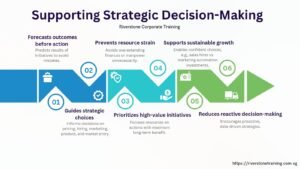
Whether it’s hiring decisions, product pricing, new product development, or capital investment, business decisions have repercussions beyond the income statement, and an integrated model reveals those repercussions before the decision is made, not after. For example, a price change impact not only revenue, but it can impact customer volume, receivables and even cash flow, which the model can follow in one step.
This provides decision-makers with a more comprehensive approach to assessing trade-offs, like the difference between faster growth and increased working capital and financing requirements, or the difference between a cost-cutting measure and increased cash generation or financing. Actions based on a true three statement perspective are more likely to succeed when you get real results.
How Can Financial Modeling Training Develop These Skills?
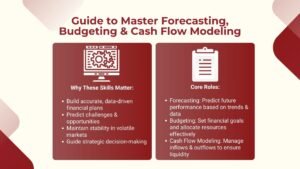
Structured financial modeling training can take a professional from accounting concepts one-by-one to putting together models that use accounting concepts in concert, such as developing a set of assumptions, building the model to forecast working capital, creating the debt schedule, forecasting cash flow and conducting scenario and sensitivity analysis. It is best here with practical exercises and case studies, as this makes it easier for the learners to understand the consequences of a single assumption change within the entire model, instead of just memorizing formulas.
A hands-on financial modeling masterclass gives professionals structured practice building these integrated models from historical data through to a completed, balanced forecast, which is difficult to develop through self-study alone since errors in linked models are often only visible once the full statement set is built and tested.
Why Is Three-Statement Modeling an Important Finance Skill?
Three statement modeling is an essential skill in FP&A, corporate finance, investment banking, equity research, financial analysis, consulting, private equity and commercial finance as it is important to understand how business decisions impact profitability, financial position and cash simultaneously. It’s used by an FP&A professional for budgeting, an investment analyst to create forecasts of future cash flows for target company valuation, and a private equity professional to determine the ability of a target company to cover its debts and support its growth.
However, the skill at the heart of the job is the same – creating a model with consistent assumptions, and where all the financial consequences of those assumptions are clearly apparent. That’s why three-statement modeling is considered a core skill for corporate finance and investment courses instead of a higher-level or elective skill.
| Skill | Why It Matters |
| Revenue Forecasting | Establishes future operating performance |
| Working Capital Modeling | Improves cash-flow visibility |
| Three-Statement Integration | Creates consistent forecasts |
| Scenario Analysis | Tests uncertainty |
| Financial Modeling | Supports planning and decisions |
How Key Changes Flow Through an Integrated Model
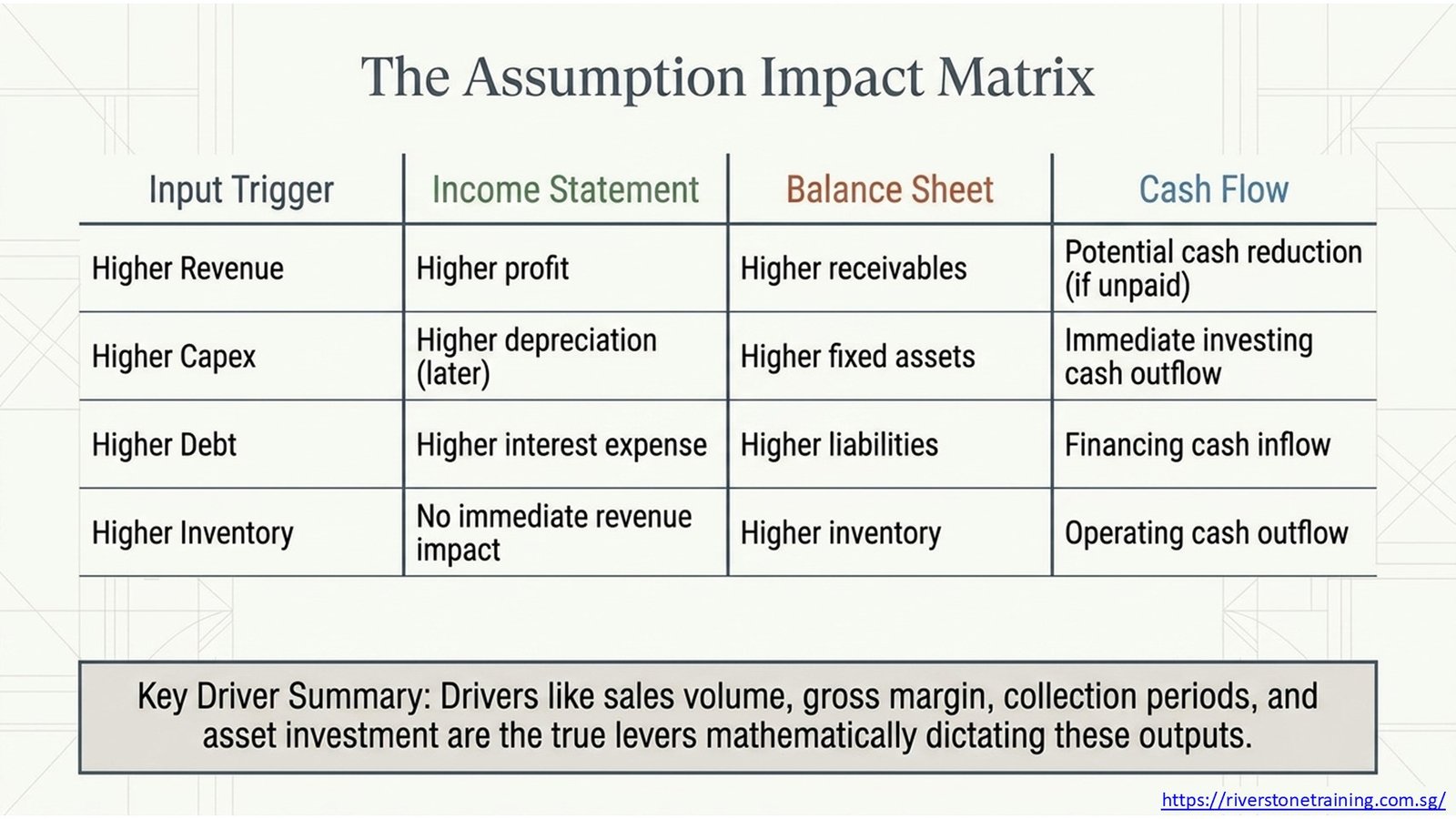
A table that shows the movement of some common assumption changes across the income statement, balance sheet and cash flow statement.
| Change | Income Statement | Balance Sheet | Cash Flow |
| Higher Revenue | Higher revenue/profit | Higher receivables | Potential cash increase |
| Higher Capex | Higher depreciation later | Higher fixed assets | Investing cash outflow |
| Higher Debt | Higher interest expense | Higher liabilities | Financing cash inflow |
| Higher Inventory | No immediate revenue impact | Higher inventory | Operating cash outflow |
Key Modeling Assumptions at a Glance
| Assumption | Example Driver | Financial Impact |
| Revenue Growth | Sales volume | Revenue and receivables |
| Cost of Sales | Gross margin | Profit and cash flow |
| Working Capital | Collection period | Operating cash flow |
| Capex | Asset investment | Cash and fixed assets |
| Debt | Borrowing requirements | Liabilities and financing cash flow |
Conclusion
A three statement model allows the financial forecast to be presented across the profitability, financial position and cash flow statements which makes it easier to track changes in revenue, expenses, working capital, capital expenditures, financing, etc. to track changes in financial forecasts, rather than just in profitability. What makes three statement financial modeling a business forecasting and planning tool and not an accounting exercise is this; it provides a comprehensive view on how business decisions impact cash, liquidity, profit and the balance sheet.
Structured practice is important for developing this skill well, as the usefulness of an integrated model is in its linking of valid assumptions, rather than just knowing what each statement means individually. For practitioners seeking to enhance their forecasting skills, the emphasis should be on hands-on modeling exercises, scenario analysis and realistic business cases which capture the true interactions between revenue, costs, working capital and financing.