A financial modeling for startups course enables entrepreneurs to make informed projections about the future growth of their venture by creating financial models that involve making informed assumptions based on data to estimate revenue generation, expenses, and funding requirements. Uses forecasting, scenario analysis and financial modelling in Excel to evaluate various growth options before investment. This enables the founders to recognize the cash deficit early, revise business decisions and put forth convincing plans to the investors.
What Is a Financial Modeling for Startups Course?
Financial modeling for startups course is a curriculum that helps startup founders and finance practitioners create, interpret, and analyse financial models for startups and early-stage businesses.
Start-up-centered courses are different from other corporate finance courses, which deal with large established organizations, in that they are directed at the reality of having little historical data, fast-changing revenue assumptions, and the necessity to plan under great uncertainty. Participants will learn how to construct forecasts from the ground up, to estimate operating costs, to model cash flow and to stress test their assumptions based on various scenarios.
One attribute of these programmes that makes them valuable is their practical aspect. Instead of just learning a theory of finance, participants create models that can be leveraged for their own businesses; these models are a tool that will help them get up and running with their business right away.
How Does Financial Modeling Help Entrepreneurs Forecast Business Growth?
Financial modeling enables entrepreneurs to predict the future growth of their business by quantifying assumptions about the business in terms of revenue, expenses, staffing, and capital needs. A good model brings together the relationship between business inputs and financial outcomes into a clear and testable relationship.
A founder looking to create a subscription business can, for instance, show how a change in monthly new users, churn rate, and average revenue per user (ARPU) impacts total revenue over a 36-month period. These inputs can be changed, and the founder will be able to instantaneously observe the effects of the various growth strategies on the finances before committing to an allocation.
Structured thinking, or moving business logic into the structure of the financial model, is the key competency that is developed through financial modeling training. It’s applicable to technology-based startups, online retailers, service providers, and companies backed by venture capital.
What Financial Assumptions Are Used in Startup Financial Models?
The inputs of any startup model are called financial assumptions. The assumptions are crucial for a startup, as they cannot be based on past experience. Market research, industry benchmarks, and informed business judgment are necessary.
Revenue growth rate, customer acquisition cost, conversion rate, average transaction value, gross margin, headcount growth, operating expense ratios and capital expenditure requirements are all common assumption categories. All assumptions should be recorded, identified and tied to a specific model output.
One of the important skills gained from financial modelling training will be the ability to recognize the variables that impact results the most and create models to enable you to test those sensitivities. The 80% of the variance assumptions deserve much more attention than those with marginal effects.
How Do Entrepreneurs Build Revenue Forecasts in Financial Models?
Revenue forecasting happens in a bottom-up or top-down approach and seasoned modellers generate forecasts using both to validate the results. Bottom-up forecasting begins at the operational level and works upward (from operational drivers to total revenue). Top-down forecasting begins at the market size and drifts down to the market share.
Bottom-up forecasting is more believable and defensible for the majority of startups because it relates revenues to specific, controllable business activities. For a SaaS startup, revenue can be predicted based on the estimate of new monthly subscribers, the monthly churn rate, and average monthly recurring revenue per user.
| Step | Activity | Objective |
| 1 | Define revenue streams | Clearly define all income sources |
| 2 | Establish driver assumptions | Set volume, pricing and conversion inputs |
| 3 | Build a bottom-up revenue model | Connect business activities with the expected revenues. |
| 4 | Set up growth rate assumptions | Project income during the forecast period |
| 5 | Cross-check with the top-down view | Check the size and market share estimates against the market. |
| 6 | Stress-test with scenario analysis | Determine implications of changes in key assumptions |
This process results in a revenue forecast that may be questioned by investors and lenders when they seek additional funding. Forecasts based on logical, auditable assumptions are much more convincing than those at a high level without supporting detail.
How Can Financial Modeling Techniques in Excel Improve Forecast Accuracy?
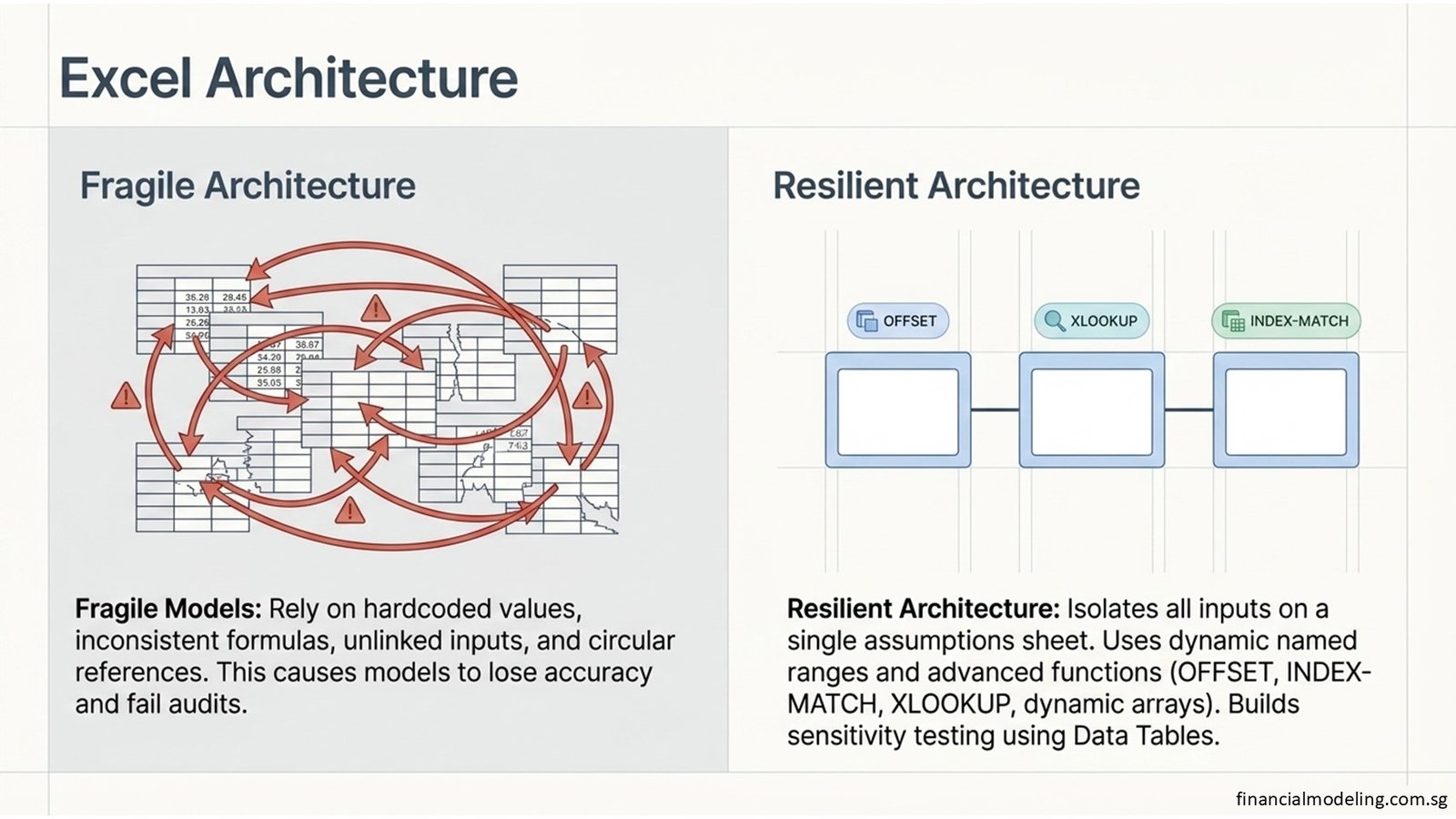
Despite other platforms becoming more widespread, Excel remains the most popular for financial modeling in startups, and being able to build accurate, auditable, and flexible financial models with Excel will remain a crucial skill. Errors in Excel practices, such as hardcoded values, inconsistent formulas, inconsistent formatting, circular references, and unlinked inputs, can skew the results and cause the model to lose accuracy.
Effective financial modeling techniques in Excel are isolating the inputs from the calculations, using dynamic named ranges, creating sensitivity tables using data tables, and formatting the model so that everything is referred to only one assumptions sheet. This architecture facilitates the auditing, updating and presentation of the model.
Advanced functions like OFFSET, INDEX-MATCH, XLOOKUP and array formulas enable analysts to create flexible model structures that support variable-length forecast periods, scenario switches, and dynamic financial statement consolidations. These tools are vital to the quality and credibility of startup financial projections.
| Model Component | Purpose | Key Outputs |
| Revenue Forecast | Estimate future sales by product, channel, or segment | Monthly and annual revenue |
| Expense Forecast | Project fixed and variable operating costs | Total operating expenditure |
| Headcount Plan | Model salary and contractor costs by role and hire date | Payroll and HR costs |
| Capital Expenditure Schedule | Plan equipment, technology, and infrastructure spending | CapEx and depreciation |
| Cash Flow Model | Track operating, investing, and financing cash movements | Net cash position |
| Funding Analysis | Estimate capital requirements and runway | Funding gap and burn rate |
| Financial Statements | Integrate P&L, balance sheet, and cash flow statement | Three-statement model |
How Does Scenario Analysis Help Startups Plan for Different Outcomes?
One of the best and most practically useful tools in startup financial modeling is scenario analysis. It creates the opportunity for the entrepreneur to simulate the various scenarios that may be faced, not to say which ones will be faced, but to see what may happen and what the effects will be on the finances.
An overview of the standard scenario structure has a base case scenario based on realistic assumptions, and an optimistic scenario with a strong execution and favourable market conditions, but also a conservative case scenario that takes the growth to be slower or adverse events to happen. Every scenario creates a unique financial profile that is used to make planning, fundraising and operational decisions.
| Scenario | Revenue Growth Assumption | Key Planning Focus | Business Implication |
| Base Case | Moderate — in line with plan | Operational execution | Predicted outcome: standard for measuring performance |
| Optimistic Case | High — exceeds current targets | Scaling capacity and hiring | Improved return to profitability, higher funding rate. |
| Conservative Case | Low — below expectations | Cash conservation and burn control | Longer runway planning, new funding schedule |
| Stress Case | Significantly below plan | Survival and capital preservation | Makes the minimum viable operations and cash floor identification |
In practice, it’s the conservative and stress cases that are more interesting than the optimistic case. Investors and board members are interested in the business’s reaction when it gets screwed up, rather than when it goes right. Scenarios can be taught to help entrepreneurs incorporate this as part of the financial planning process from the outset.
What Financial Statements Should Be Included in a Startup Financial Model?
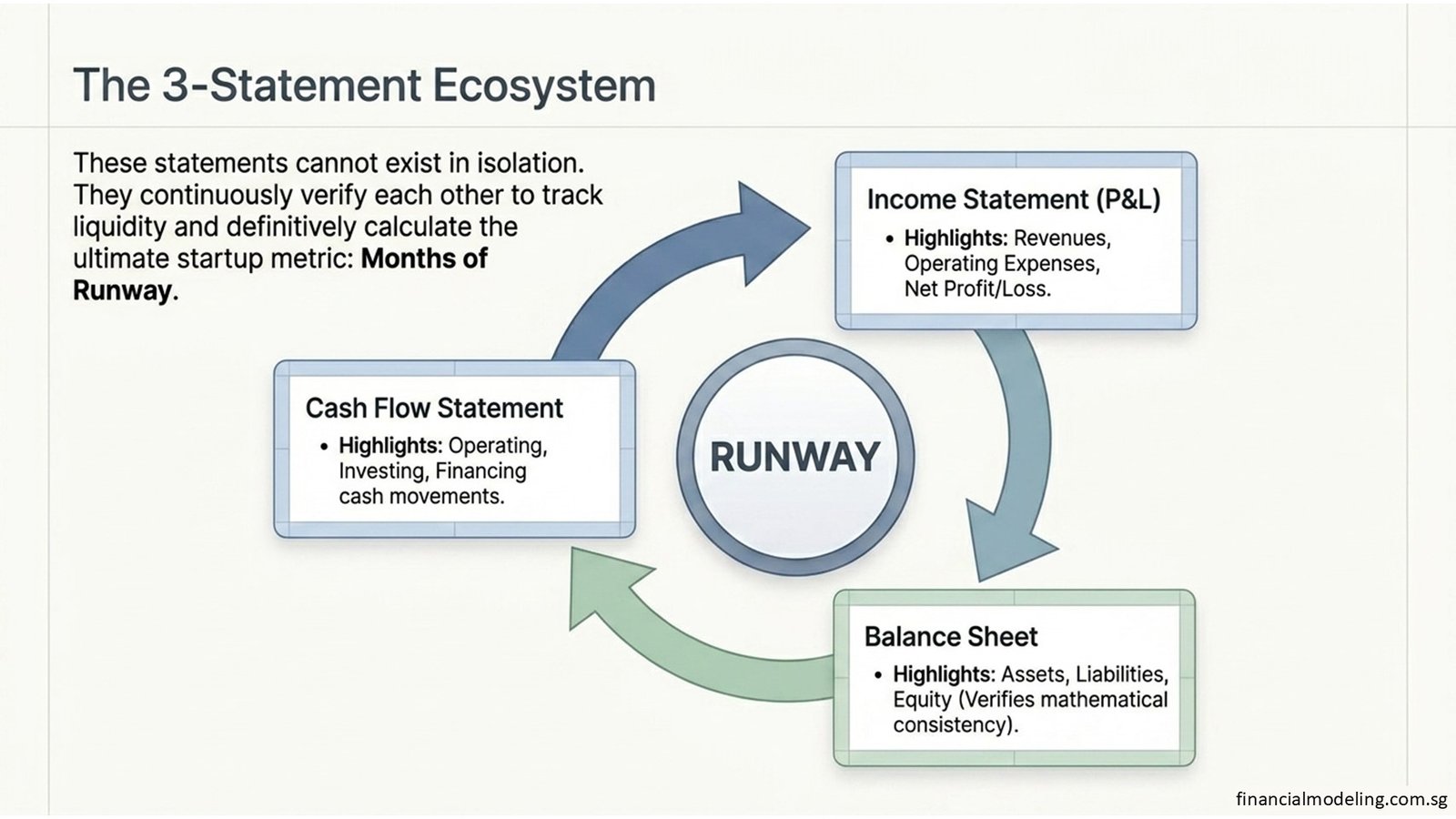
On the whole, a startup financial model will consist of three fundamental financial statements: the income statement (P&L), the cash flow statement, and the balance sheet. These statements can give a comprehensive picture of the business’s financial performance, liquidity and capital structure.
The income statement presents the revenues and gross profit, operating expenses and net profit or loss for the forecast period. The cash flow statement is essential for managing the “runway” as it records actual receipt and payment of cash, rather than the underlying values of assets and liabilities. The balance sheet represents the assets, liabilities and equity on a certain date and verifies that the model is mathematically consistent.
A lot of startup founders make the mistake of creating only a profit and loss forecast, but they don’t create the cash flow statement. Slow collections, high inventory, or timing of capital expenditures are all examples of how a business may report positive net income on a P&L statement and have negative cash flow. One of the most crucial skills taught in a Financial Modeling for Startups course is learning how to create an integrated three-statement model.
How Can Startup Financial Models Support Fundraising Decisions?
Financial models are the backbone of fundraising efforts because they provide investors with the information that they need to determine the risk, to identify growth potential, and to understand whether the valuations offered are justified. A credible model should show the unit economics of the business and the business model for profitability.
Investors will always check out the assumptions behind the revenues, gross margins, cash burn rate, total funding needs, and estimated break-even or profitable date. Investment models that make it clear how investment capital will be used – and what milestones will be reached with each tranche of investment – are far more convincing than those that just put on screen headline revenue forecasts.
If you are planning on raising a seed round, Series A, or growth round, a solid financial model is a must. It’s the document that underlies all financial claims in an investor presentation and the basis of due diligence discussion.
How Does Financial Modeling Help Entrepreneurs Manage Cash Flow?
Financial modeling is one of the best ways to predict and prevent financial shortages before they get serious, and one of the major reasons startups fail is due to cash flow management. A cash flow model shows when cash should flow in and out of your business over the forecast period, and how far you will fall into a cash crunch if your current plan is uninterrupted.
This visibility can be priceless for small businesses. If the entrepreneur notices that there might be a cash shortfall six months before, he has time to alter his spending, speed up the receivables, or start the funding process. If a founder realizes the same thing 2 weeks before payroll, there are many fewer options.
Financial modeling training helps entrepreneurs develop rolling cash flow forecasts, understand the difference between accounting profit and cash movement, and incorporate early warning metrics like months of runway in their model dashboards.
What Skills Are Developed Through a Financial Modeling for Startups Course?
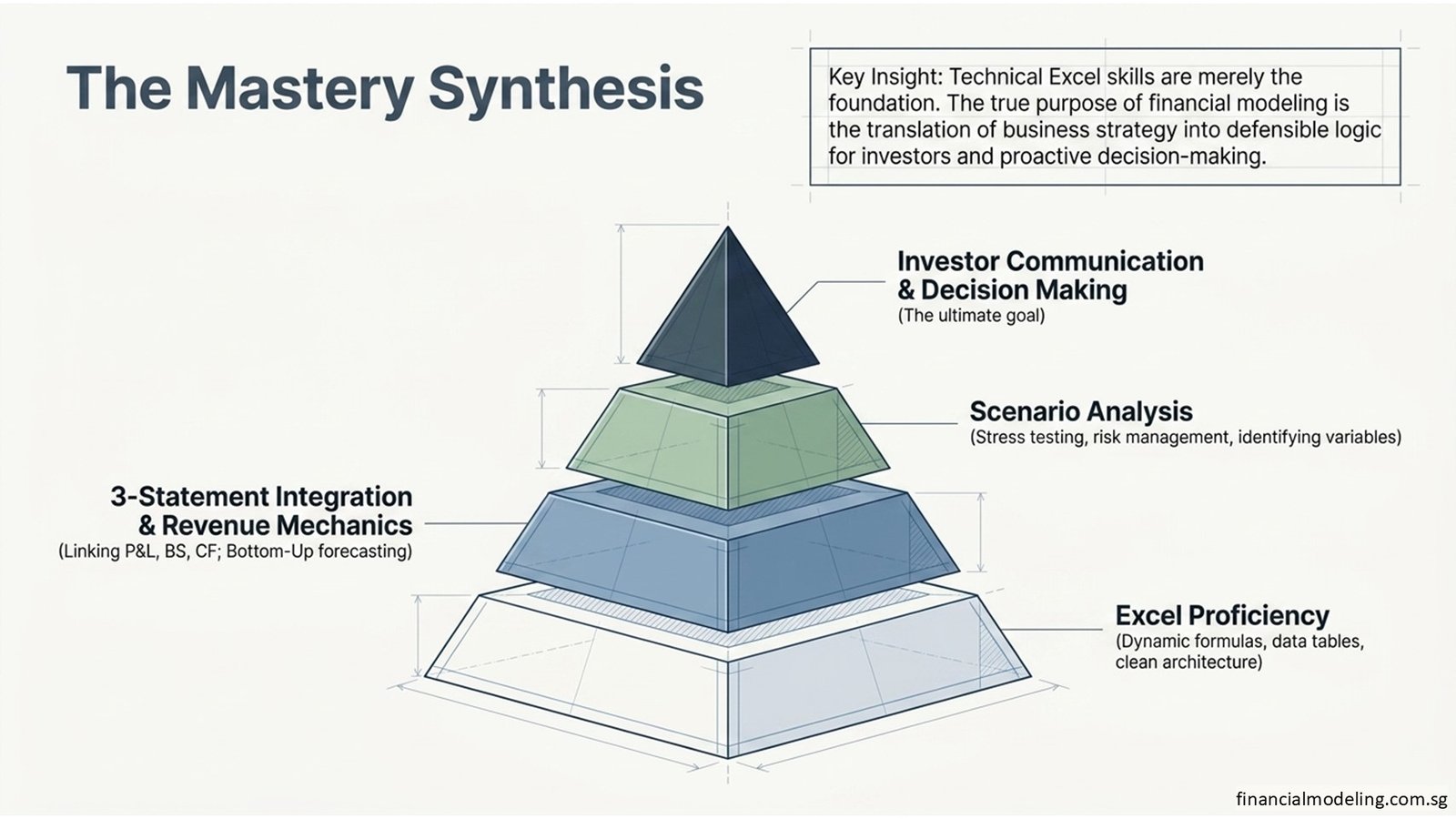
The startup financial modeling course equips students with a variety of technical and analytical competencies that can be instantly utilized in business planning and with investors.
From a technical viewpoint, the participants become proficient in the principles of Excel model architecture, formula design, scenario development, and three-statement model integration. Analytically, they learn to turn business strategy into business assumptions, understand what elements contribute most to business value, and “stress test” assumptions based on a realistic set of risks.
In addition to the mechanics, participants learn financial communication skills: the ability to communicate the logic of the models, stand up to questioning by non-financial stakeholders, and present financial projections to non-technical board, investors, and lenders.
| Skill Category | Specific Competency | Application |
| Excel Proficiency | Create models, use dynamic formulas and data tables | Building clean, auditable, flexible models |
| Revenue Modeling | Turning business concepts into financial forecasts. | Translating business plans into financial projections |
| Cost Modeling | Fixed vs variable cost structure analysis | Finding scalability and margin improvement opportunities |
| Scenario Analysis | Multi-case scenario construction and sensitivity tables | Considering uncertainty and risk management |
| Cash Flow Modeling | Cash flow projections for operating, investing and financing activities. | With the liquidity and runway.Liquidity and runway. |
| Three-Statement Integration | Linking P&L, balance sheet, and cash flow | Creating more thorough and accurate financial models |
| Investor Communication | Describing and arguing model assumptions | Fundraising and Board financial reporting. |
How Can Financial Modeling Skills Support a Long-Term Financial Modeling Career?
Financial modeling skills that a startup uses can be directly applied across a variety of careers. For finance professionals, these capabilities support a strong financial modeling career across investment banking, private equity, venture capital, corporate finance, and management consulting.
People with the skills to create the full three-statement model, develop defensible assumptions, and clearly articulate the financial logic are needed throughout the industry. The interesting thing about the startup context is that it involves working with incomplete data, starting from scratch, making judgments – all of which are things that a good modeller will have to do, but are things that most people will not do if they just fill in a template.
The skills gained in modelling during the start-up phase will also prove valuable when working as an investor, working in corporate finance, or even being an entrepreneur who will move to a more advisory role. Structured Course Learning with real-world application equips practitioners with real-world effectiveness from day one.
Conclusion
Financial modeling for startups is a hands-on tool that supports business planning, enables proactive cash flow management, and facilitates effective communication of business ideas.
Financial Modeling for Startups teaches startup entrepreneurs and finance professionals how to create revenue forecast models from first principles, how to leverage 3 statement financial models, how to perform scenario analysis and how to use Excel as a modeling tool. Such skills directly enhance business planning quality and investor readiness.
Recognising that there is no guarantee of 100% certainty in predicting the future with financial models. They are valuable because of the discipline of structured thinking they force, the assumptions they drive founders to state, and the range of outcomes they help anticipate. It may be a bad model in terms of the ‘numbers,’ but still be of immense value if it correctly identifies business risks and business decision points.
Whether you’re a business owner, an analyst, or someone looking to enter the world of financial modeling, a structured training program can yield a return on investment in any industry or scenario that involves making money decisions.
| Topic | Key Takeaway |
| Revenue forecasting | Develop operational drivers from the bottom up, and compare with market-based estimates |
| Financial assumptions | Record, collect, and test the sensitivity of each of the major inputs to the model outputs |
| Scenario analysis | Use a model to plan for uncertainty (base, optimistic, conservative and stress cases) |
| Three-statement model | Calculate and combine P&L, cash flow and balance sheet to get a comprehensive financial picture. |
| Cash flow management | Have rolling Cash Flow Forecasts in place to recognise funding gaps early on |
| Excel techniques | Isolate inputs from calculations; use dynamic formulas for auditable & flexible models |
| Career application | The skills acquired in startups are applicable to investment, advisory and corporate finance. |
The skills taught in a structured financial modelling for startups course are among the most useful and the most transferable in the field of business finance today, whether you are a startup founder, looking to make your first meeting with an investor, a finance professional with a need for new tools in your analytical arsenal, or a career changer aiming to build a career in financial modelling.