
Real Estate Financial Modeling: Valuation, Cash Flow, and Job Opportunities
Introduction
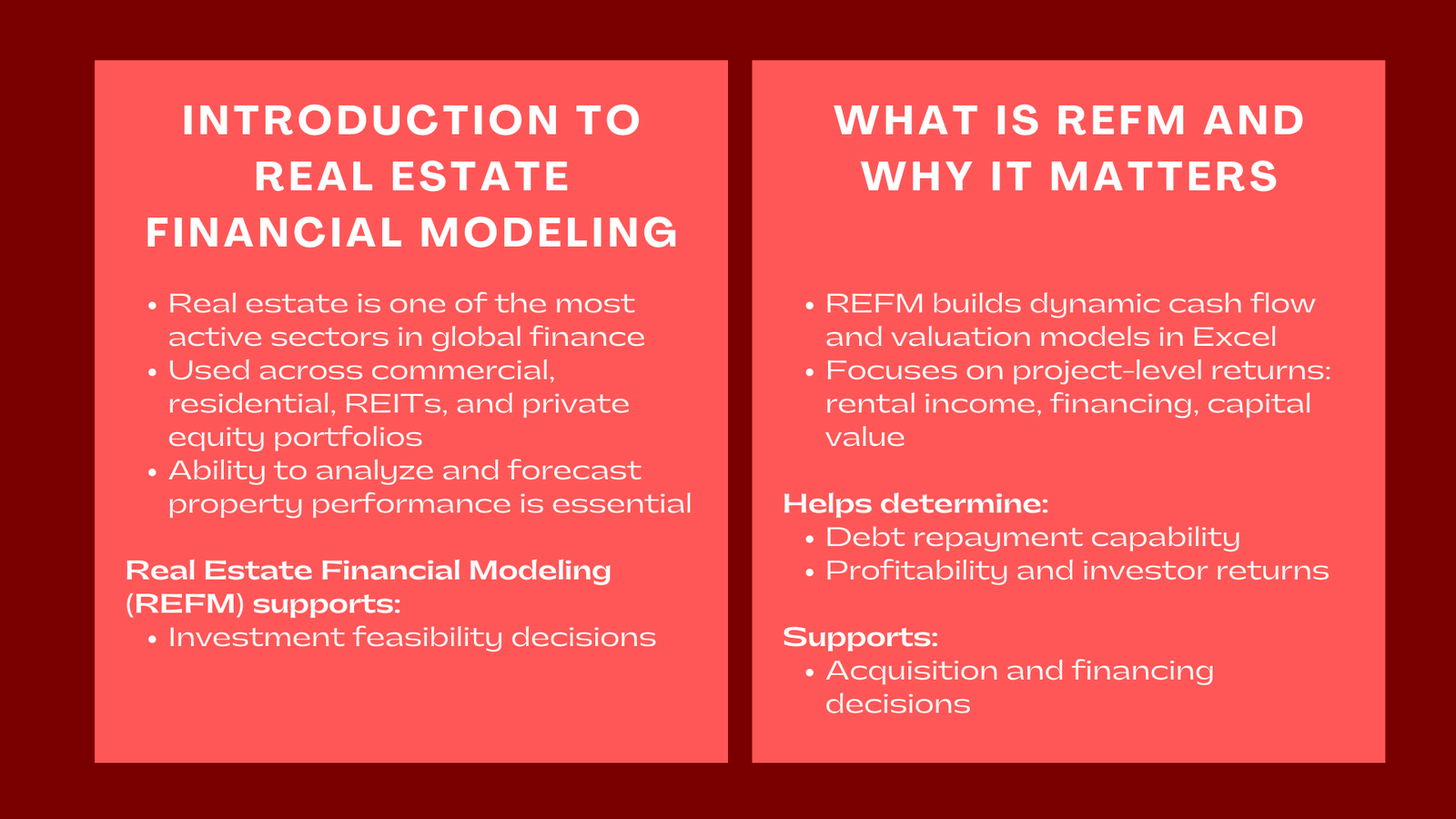
The property business is among the biggest and the most vibrant in the world finance. Whether it is commercial developments and residential projects or REITs and private equity portfolios, it is necessary to be able to analyze and predict performances of real estate. The key to this analytical power is in the financial modeling of real estate which is an essential asset when a professional wants to succeed in property investment, development, or management, especially for those pursuing a financial modelling course Singapore for finance to enhance their expertise in the real estate sector.
This field is an amalgamation of financial analysis, valuation, and forecasting which are useful in determining the viability of projects, maximizing capital structures, and investment decisions. Since the need to have a competent financial analyst persists, learning the art of real estate financial modeling has become a major point of distinction among individuals in the finance, real estate, and consulting industry.
Getting to know Financial Modeling in Real Estate.
Real estate financial modeling (REFM) is the act of creating dynamic models in Excel (or other analysis packages) to estimate property investments and developments. These models are applied in forecasting of cash flows, estimation of property valuations and the profitability and risks of real estates projects.
In contrast to company-level performance analysis in corporate finance modeling, real estate modeling analyzes returns on projects, i.e. the income of renting, the value of capital and financing. The models assist the investors and lenders in determining the ability of a property to pay off its debts and deliver desirable returns.
Simply, REFM offers the financial support of the acquisition and financing decision-making, development, and exit strategies.
Important Elements of Real Estate Financial Models.
A professional real estate financial model combines several elements in order to fully reflect the financial image of a property or portfolio.
Revenue Projections
The sources of revenue are usually motivated by the rental income, lease escalation, and occupancy rate. Incentives, tenant improvements and possible vacancies should also be taken into consideration to guarantee realistic predictions by analysts.
Operating Expenses
It is necessary to model the operating costs correctly (including property management, maintenance, insurance and taxes) in order to calculate net operating income (NOI). The slightest miscalculation may have a huge influence on valuation and returns on investments.
Financing Structure
The capital structure (debt equity) influences risk, cash flow and cash flow. Debt schedules, interest payments, and refinancing scenarios are generally incorporated in the models in order to evaluate the effect of leverage on the project profitability.
Capital Costs and Development Costs.
In case of development projects, analysts would have to project the costs of construction, land acquisition, soft costs and contingencies. These are assumptions that impact directly on the project schedules and funds.
Exit Strategy
The terminal value and the total investment yield depends on the exit strategy which could be through sale, refinancing or long-term holding. The computation of the internal rate of return (IRR) and net present value (NPV) assists the investors in comparing the project with other opportunities.
The significance of the Cash Flow Analysis.
Cash flow is king in the real estate. Knowledge on how and when cash flows in and out of a project is what defines a project as viable on a financial basis. The key milestones that are identified in cash flow modeling include:
- Construction drawdown and interest capitalisation.
- Stabilization periods and lease-up periods.
- Functioning cash receivables and receipts.
- Repayment of loans and equity dividends.
With an elaborated cash flow statement, investors would be able to assess the liquidity and resilience of a project to changes in the market.
A strong model does not only make it appear profitable but it gives one a sense of the time frame and viability of cash flow. It is this accuracy that separates those who become successful real estate investors and finance professionals and those who are not.
The reason why Real Estate Financial Modeling is necessary.
The skill of construction, analysis, and audit of financial models is a precious quality in the real estate industry. It enables professionals to:
- Measure returns of investment in various assumptions.
- Test the sensitivity to the variation of rent, cap rates, or cost.
- Make financing deals and negotiate effectively.
- Acquisitions, developments and joint venture due diligence.
- Report effectively to Lenders, investors and developers through informed data.
The need to reduce financial data to actionable strategies is increasingly on the rise among real estate markets in the world as investment opportunities are becoming more and more sophisticated.
The worth of Specialization Training.
In order to develop confidence and accuracy in financial modeling, it is required to have structured training.Many professionals now enroll in real estate financial modeling training courses for property investment professionals, which combine theoretical understanding with hands-on practice.
Such programs educate the participants to:
- Dynamically construct models written in Excel.
- Deal analysis of debt and equity investors.
- Conduct sensitivity analysis in order to test project resilience.
- Derive meaning of financial performance to guide an acquisition or development strategy.
- Match models with real life transaction information and valuation strategies.
Using actual real-world examples, including office towers, mixed-use projects or REITs portfolios, participants get to understand how to model realistic assumptions and assess risk-return profiles.
Real-life Applications in Real Estate industries.
Financial modeling is a flexible tool applicable in various classes of assets and investment approaches:
- Commercial Real Estate: This involves office buildings, retail centers and industrial assets, which need to be modeled in terms of lease, tenant churn and market rent.
- Residential Developments: Condo or housing developments have to fish out sales programs, construction expenses and pre-sale revenues.
- Hospitality and Mixed-Use Projects: The assets will require scenario-based modeling as the occupancy rates and seasonal revenues are subject to change.
- REITs and Portfolio Management: REFM is used to value diversified properties by institutional investors to predict distributions as well as measure asset performance.
The assumptions and metrics of each sector vary, however, the concept on how they are modelled is similar cash flow forecasting and risk-adjusted valuation.
The benefits of Modeling in getting a career.
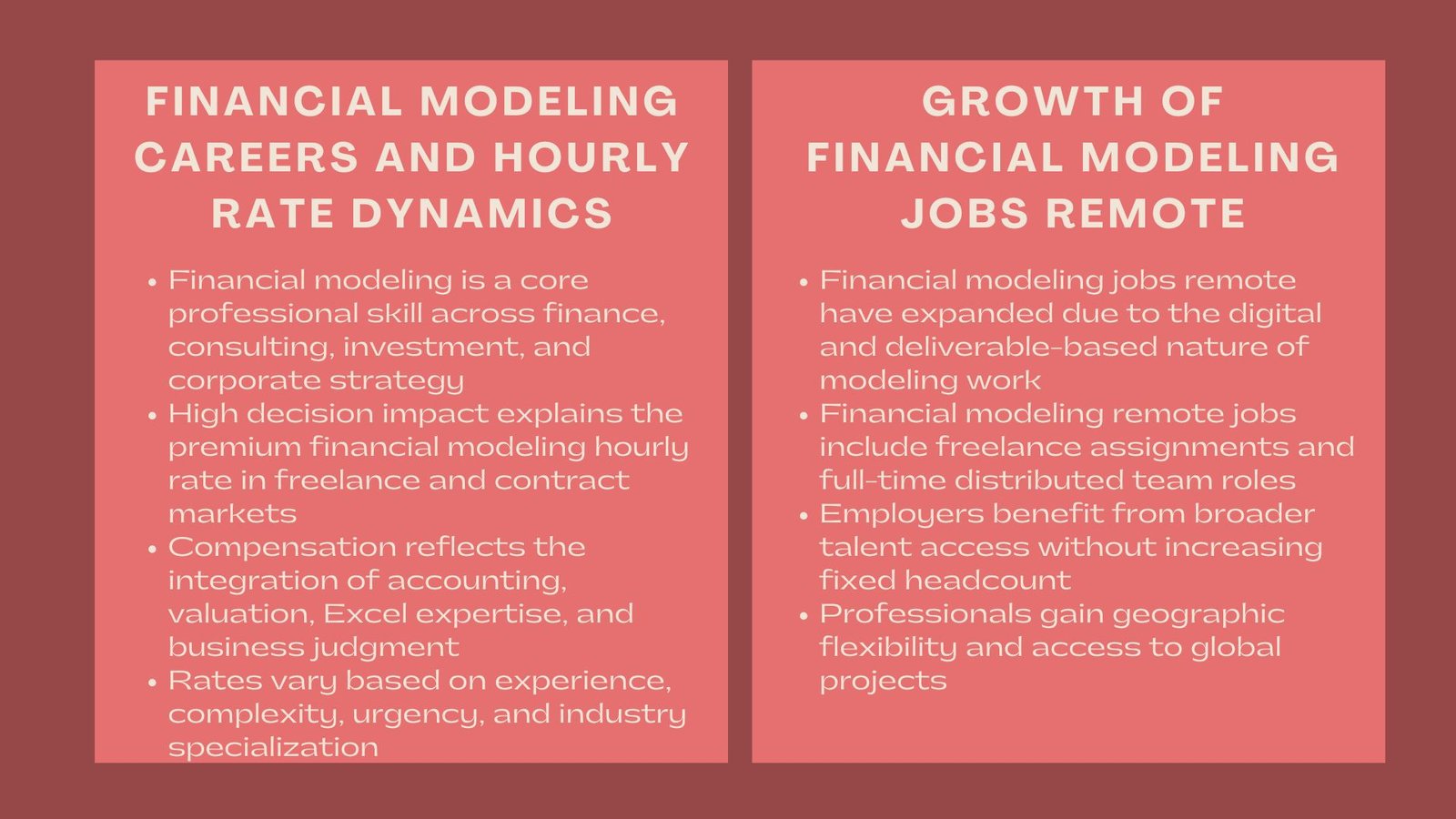
Financial modelers are in high demand in the following positions:
- Real Estate Analyst
- Investment Associate
- Finance Manager Development/Finance.
- Asset Manager
- Valuation Consultant
Moreover, increased requirements exist in the private equity companies, real estate investment trusts and investment banks of analysts capable of evaluating property portfolios utilizing sophisticated modeling tools.
Enrolling in advanced real estate financial modeling and valuation courses for corporate finance teams allows professionals to bridge the gap between theoretical finance and real-world transaction execution. The career mobility and the compensation potential of these programs is a direct result of the technical competency of these programs.
Real Estate Valuation: Much More Than the Numbers.
Although the financial models are quantitative, the real estate valuation is also qualitative. Valuation is determined by market trends, quality of tenants, location dynamics and economic conditions.
Financial modeling will allow practitioners to incorporate these qualitative influences into quantitative systems in such a way that they come up with comprehensive valuations that are in line with the expectations of the investors. The art and science of valuation helps one to spot underpriced opportunities and risk management.
The Future of Real Estate Modeling with Technology.
Technological advancement has kept transforming financial analysis of real estate. It is now being done with cloud-based tools, automation, and artificial intelligence to achieve accuracy and efficiency.
The more sophisticated platforms enable the analysts to couple models with real-time market data making the process of updating the model as well as analysis of scenarios easier. Simultaneously, visualization tools allow more effective transmission of the outcomes of the model to the stakeholders and investors.
When the industry is going through the digital transformation, the professionals who will be able to integrate the technical modeling skills with the technological fluency will have a clear competitive advantage.
A Long-Term Real Estate Finance Career.
It is not only technical skills that would give one a success in the real estate finance industry, it takes strategic thinking and expertise, detail and a good communication skills. Financial modeling is a facilitator between technical knowledge and strategic decision making.
Those professionals in the context of constant improvement of modeling and valuation skills can analyze the intricate transactions better, negotiate with the stakeholders, and provide insights that can influence the multi-billion investment decisions.
Financial modeling allows analysts to be prepared to take up work in investment management, development advisory, and asset optimization- areas which are still growing across the world.
Conclusion to Real Estate Financial Modeling Valuation Cash Flow and Job Opportunities
Financial modelling of real estate is a foundation of investment and finance in modern real estate. It enables the professionals to examine, predict, and streamline the performance of real estate resources in industries and cycles.
Through appropriate training and by incorporation of the best practice in Real Estate Financial Modeling: Valuation, Cash Flow and Job Opportunities, one will have a strong background in creating rewarding careers in one of the most resilient and profitable businesses in the world. With the increased need of data-based decision-making, individuals with solid modeling skills will keep defining the future of the real estate industry as seen across the whole world.