
Banking and Financial Institution Modeling: Key Skills for Career Growth
Introduction
Banks and other financial institutions are under a very high demand to influence the economic growth, investment and risk management in the fast-paced world of finance. Professionals require sophisticated analytical software to aid these intricate tasks to measure performance, risk, and estimate financial performance. Banking and financial institution modeling is one of the most essential technical skills of finance today- a professional area allowing analysts to analyze the financial information, predict the trends, and take important strategic decisions.
The preparation of modeling skills will not only increase the level of decision making but also open a wide range of career opportunities in the field of investment banking, credit risk, corporate lending, and financial consulting. With the financial environment undergoing digital transformation and pressure to comply with regulations, the skill to create strong and dynamic financial models is turning out to become a critical requirement to career advancement, especially for those pursuing financial modelling training Singapore investment banking to strengthen their technical expertise and industry readiness.
Doing the Banking and Financial Institution Modeling.
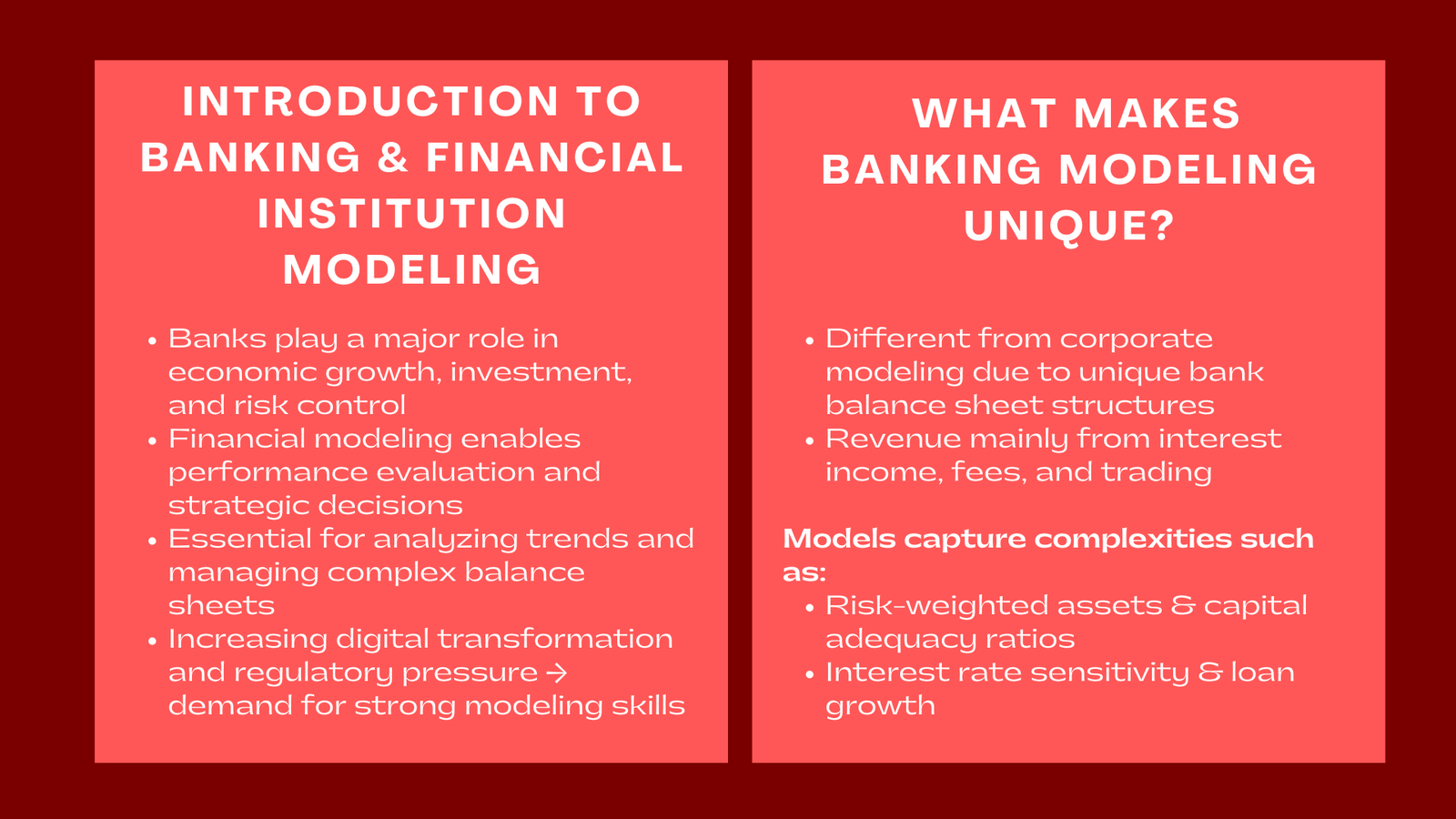
Financial modelling within banks is not similar to the conventional corporate modelling due to the fact that the financial institutions are under different balance sheet designs and financial regulatory frameworks. The main sources of revenue to the banks are in the form of interests and fees and trading and as a result the assets and liabilities of the banks will always be varying as a result of market dynamics and clients.
The modeling of banking and financial institutions entails the development of models that capture such complexities- the risk-weighted assets, capital adequacy ratio, loan growth forecast and interest rate sensitivities. These models allow the analysts to have a model of the financial health of a bank in varying economic conditions, profitability, and adherence to regulatory limits of Basel III or IFRS 9 compliance.
Fundamentally, this is aimed at developing a clear and adaptable structure of comprehending the influence of a number of factors namely; credit quality, interest rates, liquidity and capital structure on the performance and valuation of a bank.
Financial Modeling and the Banking Industry.
Financial modeling is the basis of making key business and regulation decisions in banking. Professionals need to use models to:
- Predict loan and deposit development.
- Project net interest margins (NIM)
- Interpolate capital sufficiency and regulatory ratios.
- Stress test and scenario analysis.
- Portfolios and banking assets: Value.
- Credit risk and loan performance of loans.
A healthy model helps to give a clear insight into how the revenue streams and cost structures relate to each other, which means that the banks can plan better and the investors can value the financial institutions in a better way.
Fundamental Buildings Blocks of a Banking Model.
Balance Sheet Modeling
The balance sheet is the key pillar in any bank model. It consists of elaborate forecasts on loans, deposits, investments, and sources of funds. Analysts need to know how interest earning assets and interest bearing liabilities work to predict net interest income.
Income Statement Projections.
Banks also earn interest as well as non-interest income in the form of trading gains, fees, and commissions. The strong model must be able to reflect these sources of revenue and to correlate them with operating expenses and loan loss provisions.
Capital Adequacy and Risk-Weighted Assets.
It is important to model the capital ratios (e.g., CET1, Tier 1, Total Capital) and risk-weighted assets (RWA) to determine the regulatory compliance. The analysts model the changes in capital buffers due to variations in lending, investments or risk exposure.
Loan Loss and Credit Risk Modeling.
The direct effect of credit performance is on profitability. To estimate the financial effect of possible defaults, models use the expected credit losses (ECL), loan impairment charges and provisioning.
Sensitivity Analysis and Scenario.
Scenario modeling enables banks to put their balance sheets through a stress test in such cases as an interest rate shock or in a downturn. The sensitivity analysis assists in determining the variables that influence the most the profitability and risk exposure.
The importance of Modeling Skills in the Banking Skills of a career.
Financial modeling fills the gap between decision-making and theory. In banking, the skill set can raise the level of analytical rigor and offer a competitive advantage in a number of career paths. Those in the profession who are able to master modeling can:
- Assess the strategic plans like mergers, acquisitions and capital restructuring.
- Encourage regulatory reporting and compliance requirements.
- Enhance precision of revenue and credit outcomes forecasting.
- Make current evidence-based suggestions to the top management.
The proficiency of modeling is indicative of technical skill coupled with strategic skill, which is desirable in the development of a career on the part of the financial institutions
Specialized Training for Banking Professionals
Many finance professionals develop modeling skills through advanced banking and financial modeling courses for finance professionals, which combine theory with practical application. The courses enable the participants to learn how to develop integrated financial models based on banks and other financial institutions.
- Using case studies and practical exercises, the participants will know how to:
- Develop more comprehensive balance sheet and income statement projections.
- Calculation of risk-weighted assets and capital adequacy ratios.
- Perform valuation of the banks by employing techniques such as Dividend Discount Model (DDM) and Residual Income Model (RIM).
- Turn to sensitivity and scenario analysis in accordance with regulation schemes.
This systematic methodology will see to it that not only do the learners learn the mechanics of modeling but also learn about the strategic concerns of their analyses- skills that can be transferred at the highest level to the banking functions and the worldwide markets.
The use of modeling within the banking departments.
Financial modeling is applied in various branches of a bank, each of them has its specific focus:
- Corporate Banking: Loan pricing models are used to evaluate credit risk, set the right interest margin and to design lending products.
- Investment Banking: This is a position of calculating deals and mergers by utilizing valuation and merger models which are used by advisors to guide their clients and assist in the capital market transactions.
- Risk Management: Risk models compute default, liquidity and interest rate risks.
- Treasury and ALM (Asset-Liability Management): Modeling is useful in maximizing funding policies and balance sheet risk management.
- Retail and Digital Banking: Data-driven modelling assists in profiting product and predicting the customer behavior.
The knowledge of such applications enables the professionals to match their modeling skills with business needs and add value to their organizations in terms of strategy.
The Increasing Need in the Model-Driven Decision-Making.
Since the banking industry is more data-driven, predictive analytics and automation have become the basis of decision-making. The use of digital tools, as well as AI, in modeling processes will enable more accurate forecasting gradually faster.
The contemporary banking teams are supposed to not only develop models, but also interpret and discuss their results. This is changing and it needs professionals to possess business savvy, technical skills and regulatory knowledge.
Institutions are in search of analysts that can code the model insights into risk management, profitability and growth strategies.
Banking and Financial Modeling Career Opportunities.
Financial modeling expertise provides a way to a variety of career prospects, such as:
- Credit Risk Analyst
- Financial Planning and Analysis (FP & A) Specialist.
- Investment Banking Analyst
- Treasury Analyst
- Regulatory Reporting Consultant.
- Banking Strategy Associate
For those aspiring to advance in these roles, enrolling in banking and financial institution modeling and valuation training for corporate finance teams provides a structured and practical route to mastering key concepts. The participants acquire not only the knowledge of modeling, but also the profound insight into the necessity to process the financial data in the regulatory and strategy context.
Regulation and its Implications on Financial Modelling.
The changing regulatory requirements need to be reflected in the banking models. Banks have been transformed in terms of risk and capital adequacy assessment through frameworks like Basel III, IFRS 9 and stress testing guidelines among others.
When professionals are aware of these structures, they will be able to come up with conforming models to enable the banks to be transparent and resilient when they are subjected to regulatory reviews. This is becoming a valuable knowledge in the areas of consulting, internal auditing and financial control.
With the advent of the incorporation of sustainability into the banking system, new modeling techniques are now taking into account the ESG factors- measure the effect of environmental, social and governance issues in credit and market risk.
Implication of Technology in the Banking Models in the contemporary world.
Technology has been making a rebirth in financial modeling. More developed analytics, Python-based tools, and cloud systems help banks to automate upgrades of models, improve the accuracy of data, and decrease manual errors.
This tendency should emphasize the significance of lifelong learning. Finance workers who are able to combine old-fashioned modeling abilities and technological innovation will stay ahead in a fast developing industry.
Conclusion to Banking and Financial Institution Modeling Key Skills for Career Growth
Banking and financial institution modeling is not a technically oriented process but a strategic ability that helps in enabling professionals to comprehend risk, work optimally and make evidence-based decisions.
With the ability to master the skill Banking and Financial Institution Modeling: Key Skills to Career Growth, the barriers to success in the world of global banking and financial services will be shattered as the finance professionals will have the ability to enhance their knowledge, contribute to the success of the institution, and enjoy numerous opportunities. With the sector in constant development, individuals with sophisticated modelling and analytical capacity will be needed in order to develop the future of finance.