Strategic FP&A Modeling for Finance
Financial Planning & Analysis (FP&A) is the blending of accounting, strategy and analytics. Where accountants tend to focus mainly on the past, FP&A practitioners are looking to the future. They create the models, forecast the scenarios, and interpret the numbers and translate them into business stories for management. In any finance career, it is no longer enough to be competent in FP&A financial modeling – you need to be skilled.
FP&A has seen significant change in the last ten years. Employers are now expecting their FP&A professionals to look beyond fixed annual plans, and adopt rolling forecasts, business planning and scenario modelling. This has elevated the requirements for a good finance professional. Finance professionals who commit to taking advanced financial analysis courses and who can showcase technical expertise and business savvy are in demand.
This article is intended for entry- to mid-level finance professionals – those who are either developing their FP&A skill set for the first time, or formalising the skills they have learnt on the job. It provides an overview of the essential elements of strategic FP&A modeling, explores processes and challenges faced in the workplace and provides tips for career development. This article will equip you with the knowledge and tools to take the next step in your career or to better prepare you for your next role, whether you are looking to advance your current role.
What Strategic FP&A Modeling Actually Involves
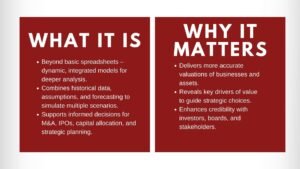
Common misconceptions of FP&A practitioners are that FP&A is all about spreadsheets. However, the spreadsheet is simply the medium – the essence of FP&A is knowing the business drivers, asking the right questions, and presenting the uncertainty in a way that is helpful to the business. The FP&A model is a dynamic representation of the business: it ties revenue forecasts to costs, links the workforce plan to the amount of production, and forecasts financials.
Lending FP&A to business strategy is more complex and more challenging than simply publishing financial results. While a monthly close provides a retrospective view of the business, a strategic model is used to answer “what if” questions – how will revenue margins be impacted if the price of raw materials goes up by 15%, or what will be the break-even point for a new product? These are not questions that can be answered with just a knowledge of Excel. They require knowledge of how businesses function, how various assumptions impact the future and how to design a model so that others can test and probe it.
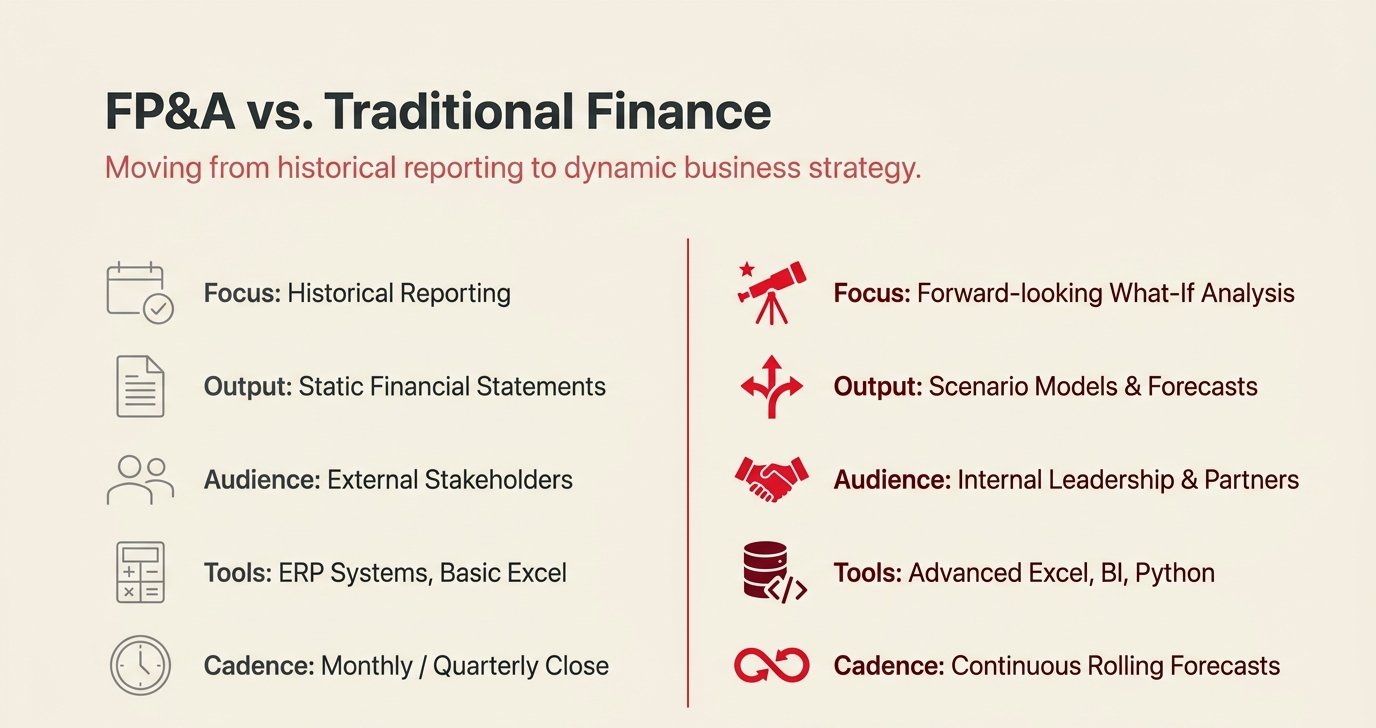
FP&A vs. Traditional Finance: A Comparison
| Dimension | Traditional Finance | Strategic FP&A |
| Focus | Historical reporting | Forward-looking analysis |
| Output | Financial statements | Scenario models & forecasts |
| Audience | External stakeholders | Internal leadership |
| Tools | ERP systems, Excel basics | Advanced Excel, BI, Python |
| Cadence | Monthly/quarterly close | Continuous rolling forecasts |
The above table highlights the need for a different mindset in FP&A. The teams in this role are internal consultants to the business – they need to have the technical expertise to build a model and the ability to communicate the insights to the business. Taking advanced financial analysis courses can help this process by offering both structure and experience in building models.
Five Steps to Building a Strategic FP&A Model
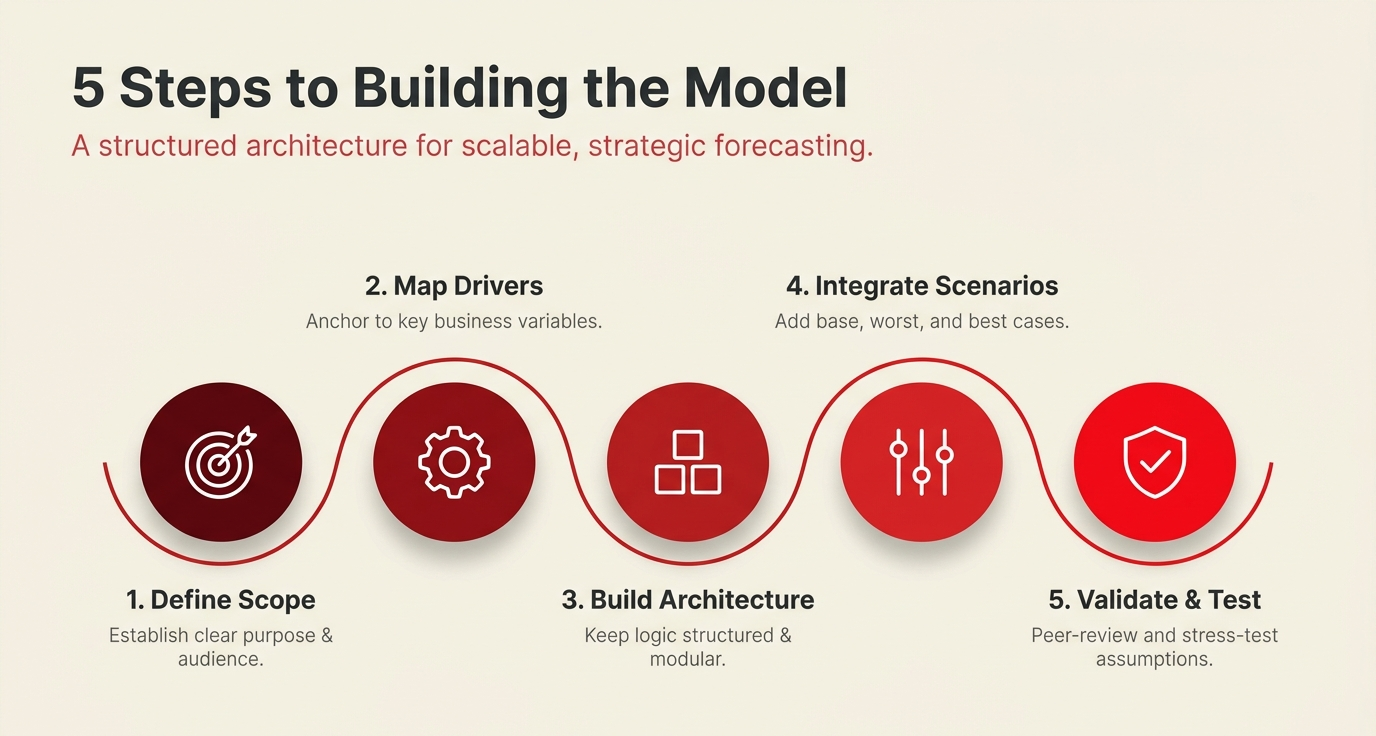
FP&A models are not created in a one-day formula-fest. It’s constructed, validated, and perfected. Here are the five steps to building a good financial model, regardless of industry or company complexity, that seasoned FP&A professionals take.
Step 1 — Define the model’s purpose and scope. Determine what the purpose of the model is and who will be using it before you start modelling. The needs of a 3-year strategic model used by a private equity investor are different from those of a monthly budget model used by a department. One of the biggest issues with FP&A models is scope creep, so be clear on the scope of the model.
Step 2 — Map the key business drivers. For every company, there are a few key variables – revenue per user, utilisation, average selling price, and people ratios – that have a large impact on your financials. Explicitly identify and build these into the model. Driver-based models are much simpler to maintain, review, and communicate than models based on arbitrary line items.
Step 3 — Build a structured, modular architecture. Organize your assumptions, calculations and reports in different sections or tabs. This makes it easier for your colleagues to understand your logic and logic errors in your formulas, and facilitates scalability. Adhere to a naming convention, avoid circularity where possible and add comments in comment boxes if logic is not straightforward.
Step 4 — Integrate scenario and sensitivity analysis. Models are never 100% correct. Use at least three scenarios when developing a strategic model – a best case, worst case and base case. And add in sensitivity tables that display how your key metrics (EBITDA, free cash flow, working capital) change with variations in your most uncertain assumptions. That will transform any forecast into a powerful planning tool.
Step 5 — Validate, peer-review, and stress-test before presenting. FP&A models are used to inform decisions about where to invest capital, so it’s important to get it right. Be sure your financial statements make sense (assets should equal liabilities plus equity; cash flow should reconcile to the beginning and end balance sheet). Have one of your colleagues review the model before presenting it to your board.
Processes, Real-World Applications, and Lessons Learned
Process is as important as technique. The most technically advanced model will not be used if it is not created in close collaboration with the business, or if it is too late to be used in making a decision. The two process flows on the next two pages illustrate how best practices FP&A teams conduct their most important recurring processes – the annual budgeting cycle and the rolling forecast.
Process Flow 1: Annual Budgeting Cycle
| Stage | Activity | Owner |
| 1 | Establish corporate goals and growth rate | CFO / Senior Leadership |
| 2 | Provide budget templates to heads | FP&A Team |
| 3 | Business Units provide bottom-up cost/revenue information | Business Unit Leaders |
| 4 | FP&A aggregates and ensures no gaps and overlap | FP&A Analyst / Manager |
| 5 | Challenge sessions and revision cycles | Finance Business Partners |
| 6 | Budget Lock / Board Final Sign Off | CFO / Board |
Process Flow 2: Monthly Rolling Forecast Update
| Step | Task | Frequency |
| 1 | Extract data from ERP and reconcile to GL | Monthly |
| 2 | Update driver-based assumptions (volumes, price, FX) | Monthly |
| 3 | Run model – check vs. last month’s forecast | Monthly |
| 4 | Prepare variance commentary and management pack | Monthly |
| 5 | Present to management; document decisions and risks | Monthly |
| 6 | Update long-term plan and scenarios | Quarterly |
Take the story of a medium-sized European consumer goods firm that transformed its FP&A after buying out two smaller brands. Pre-acquisition, each company had its own budgeting process, with different templates. After the acquisition, the group FP&A team was faced with integrating three plans into an integrated model, and they were under time constraints. The takeaway from this experience was clear: the design of the planning model at the start of the planning cycle sets the architecture, and it is difficult and costly to alter it during the year. By building a standardised, driver-based, consolidation model prior to the next budget cycle, they were able to shorten their consolidation time from 6 weeks to 10 days.
A second example is of a North American technology company that moved from annualised static budgeting to a quarterly rolling forecast. The FP&A team had become disheartened at the annual budget being out of date after only three months, in a business where the revenue for a product could change dramatically on the basis of a single contract with a customer. The team was able to provide the CFO with a much improved view of the business by switching to a rolling 12-month outlook and basing all assumptions on key business drivers, such as conversion rates, average contract size, and churn rates. Improved budgeting and forecasting skills by the team, through a combination of experience and training, were crucial to the success of the transition.
Common Challenges and How to Navigate Them
The most experienced FP&A professional will face challenges that have a detrimental effect on the quality of their work. The key to avoiding these challenges is to identify them as soon as possible. The table below lists the typical problems and the solutions that successful teams use.
Common Modeling Pitfalls and Remedies
| Common Pitfall | Recommended Remedy |
| Hard-coded assumptions buried in formulas | Locate all inputs in the assumptions tab |
| No version control on model files | Use naming conventions and a change log |
| Circular references left unresolved | Set iterative calculation or reorganise logic |
| Models with only one scenario for management | Include base, upside, and downside scenarios in the model |
| Models not tested prior to board meetings | Create sensitivity and peer reviews |
The other main challenge with FP&A – aside from technical issues – is the interaction between finance and the rest of the business. The success of FP&A models depends on the quality of their assumptions, which in turn depends on information provided by the sales, operations, or supply chain teams, who may not be as familiar with financial concepts. Developing deep knowledge across the business – and knowing how to ask the right questions to get specific, helpful answers – is a learned skill not taught in spreadsheet classes. This skill is learned, earned, and earned again by demonstrating an interest in the business.
Risk management also comes from striking the right balance of model complexity and simplicity. A model that covers a lot of ground in theory, but takes more than a full day to update, poses its own perils. It is always best to apply the simplest model to get the answer to the question at hand, with acceptable confidence. Inexperienced professionals in particular can be tempted to create complex models to impress with technical know-how. Ultimately, the most-valued FP&A professionals are those who can provide fast, clear and reliable results – and communicate their assumptions in simple terms to non-finance stakeholders.
Building Your FP&A Skill Set for Long-Term Career Growth
The good news for aspirational finance professionals is that the finance skills required for FP&A – financial modeling – can be learned and applied across industries. The financial model for a retail company is based on the same principles as the financial model for a hospital or an industrial company – it might have different drivers, but the linking of assumptions to results to statements is the same. This is one of the reasons that FP&A careers are in such demand: as modelers, FP&A professionals can transition between industries over their careers.
Structured learning helps to speed up learning. More advanced financial analysis courses – whether delivered by professional associations (such as the CIMA or ACCA), dedicated finance training providers, or quality online course providers – offer both theoretical and practical model-building training. When considering different courses, choose those with more advanced skills than simple Excel functionality, including driver-based modeling, scenario building, and how to communicate financial analysis to a non-finance audience. Being able to convey the results of a model is as important as being able to build the model.
In addition to formal training, to become proficient in budgeting and forecasting, you need to practice. Ask to work on projects where you will have to build models, rather than work on what already exists. Ask for feedback on your forecasts and models from senior managers, not only on the numbers but also on the logic, assumptions, and communication. And with time, that blend of technical, business, and communication proficiency will make you a strategic FP&A practitioner – someone who makes a difference beyond numbers.
Conclusion: Actionable Insights for FP&A Practitioners
Strategic FP&A modeling is a highly valued – and highly challenging – aspect of finance. It demands technical, business, and communication skills; the ability to present analysis in a manner that informs decision-making. The learning path to becoming proficient in this discipline is well defined for entry and mid-level finance professionals, if not always a fast one.
Let’s take five lessons from this article. First, work hard at building your FP&A financial modeling skills – before you need them. Create models for practice outside of work, observe the models of others and ask for feedback.
Second, focus on model structure and not model complexity. The simpler and more transparent the model, the better – a huge, complicated sheet that only you understand is not better. Third, develop your budgeting and forecasting skills by gaining a deep understanding of the business drivers in your industry – in other words, the more you know about what drives revenue and cost in your business, the better your forecasting will be.
Fourth, take advanced classes in financial analysis that are technical and commercial. These should contain a combination of modelling skills and business strategy, and include case studies. Finally, and most importantly, develop the communication skills and relationships to have an impact. The most effective FP&A professionals are the business’s trusted advisors – and that requires a well-planned discussion.
The companies that are best positioned for success in today’s world are those with finance teams that project change, model the risks, and help the company navigate the uncertainties. Building the skill – in yourself and in your finance team – is one of the best things you can do as a finance leader.