Preparing for Financial Modeling Interviews: Job Tips and Sample Questions
Introduction to Preparing for Financial Modeling Interviews Job Tips and Sample Questions
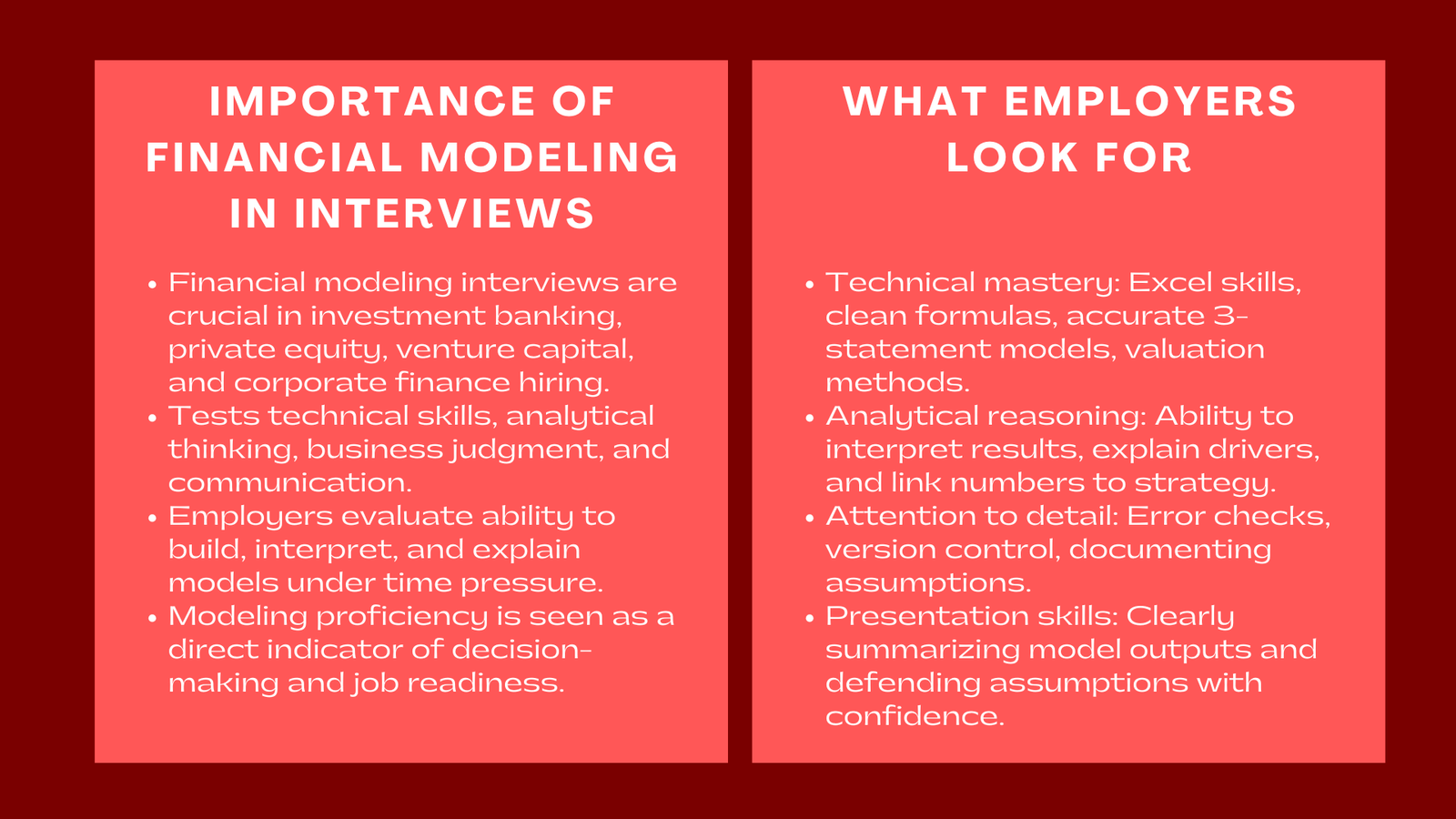
Financial modeling interviews represent one of the most critical gateways to a career in finance. Whether applying for investment banking, private equity, venture capital, or corporate finance roles, candidates are expected to demonstrate both technical competence and analytical thinking under pressure. Employers use modeling interviews to assess not only a candidate’s ability to construct and interpret models but also their judgment, communication skills, and business intuition, especially for those preparing through financial modeling Singapore for jobs interviews.
Unlike traditional interviews that focus on behavioral traits, financial modeling assessments test how well candidates can translate financial concepts into structured, logical frameworks. They measure precision, efficiency, and insight — qualities that differentiate top performers in high-stakes financial environments.
This article provides a comprehensive guide to preparing for financial modeling interviews. It explores what employers look for, outlines the key technical and conceptual areas tested, explains how to approach case studies and time-based modeling tasks, and presents sample questions designed to help candidates build confidence and readiness for their next interview.
Understanding the Role of Financial Modeling in Interviews
Why Financial Modeling Is Central to Hiring Decisions
In the world of finance, modeling is not merely a skill — it is a reflection of analytical discipline and decision-making ability. Financial institutions and corporations rely on models to value companies, assess investments, forecast performance, and allocate capital. Therefore, the ability to build and interpret these models accurately is fundamental to success in roles that involve financial analysis and strategy.
Interviewers view modeling proficiency as a proxy for a candidate’s overall readiness. A well-designed model demonstrates not only technical mastery but also structured thinking, attention to detail, and the capacity to communicate complex financial information clearly. In many firms, modeling exercises carry as much weight as — if not more than — traditional interviews because they directly test the skills required on the job.
Types of Roles That Require Financial Modeling Proficiency
Financial modeling skills are indispensable across several professional paths. In investment banking, models are used for mergers and acquisitions (M&A), leveraged buyouts (LBO), and discounted cash flow (DCF) valuation. In private equityand venture capital, models assess deal viability, investment structure, and exit scenarios. In corporate finance and FP&A, they inform budgeting, forecasting, and strategic planning.
Candidates applying for these positions should expect interviews to test their ability to build models quickly and accurately while interpreting results with clarity. Understanding the purpose of modeling within each role allows candidates to tailor their preparation accordingly — emphasizing valuation, scenario analysis, or operational forecasting depending on the target position.
Key Competencies Employers Evaluate
Technical Mastery and Logical Structure
At the most fundamental level, employers assess a candidate’s ability to build robust models in spreadsheet software such as Microsoft Excel. They evaluate formula accuracy, efficiency, and consistency in linking financial statements. A well-structured model reflects a disciplined thought process: inputs are separated from calculations, assumptions are documented, and outputs are clearly summarized.
Interviewers often test candidates’ ability to build a three-statement model — integrating income statement, balance sheet, and cash flow statement — under time constraints. They may also ask candidates to conduct valuation exercises using DCF or comparable company analysis. Clarity, speed, and logical integrity are critical indicators of competence.
Analytical Thinking and Business Understanding
Technical precision alone does not guarantee success. Interviewers also assess analytical thinking — the ability to interpret numbers in context and derive insights from model outputs. Strong candidates demonstrate an understanding of what drives value in a business, how financial ratios relate to strategy, and how assumptions interact across the model.
For example, when presented with a model scenario showing declining margins, an exceptional candidate explains potential causes (such as cost inflation or pricing pressure) and articulates possible corrective actions. This synthesis of financial analysis and business reasoning distinguishes professionals who can move from data to decision.
Attention to Detail and Error Management
Modeling interviews often include intentional data inconsistencies or incomplete information. Interviewers observe how candidates identify errors, reconcile mismatches, and verify accuracy. Candidates are expected to maintain composure, apply validation checks, and document assumptions clearly.
Demonstrating a systematic approach to error management signals professionalism. Employers value candidates who prioritize accuracy over speed, recognizing that reliable models are the foundation of sound financial decisions.
Preparing for Financial Modeling Assessments
Mastering the Technical Foundations
Preparation begins with reinforcing core modeling skills. Candidates should be comfortable with financial statement linkages, depreciation schedules, working capital movements, and interest calculations. They must understand how to structure models efficiently — avoiding hardcoding, using consistent cell references, and ensuring transparency.
Reviewing fundamental valuation methods is essential. Candidates should be proficient in constructing DCF models, calculating weighted average cost of capital (WACC), estimating terminal value, and interpreting results through sensitivity analysis. Likewise, familiarity with relative valuation methods such as comparable company and precedent transaction analysis enhances readiness for interview tasks.
Practicing with real case studies or previous interview examples allows candidates to develop fluency in building models from scratch. Time-constrained exercises are particularly useful in simulating interview conditions.
Strengthening Conceptual Knowledge
In addition to technical practice, candidates must revisit financial and accounting concepts. Interviewers often test understanding of topics such as revenue recognition, accrual accounting, capital structure, and cash flow classification. These questions assess whether candidates can explain the financial logic behind their models, not just produce numbers mechanically.
Candidates should also review industry-specific modeling nuances. For instance, energy projects may emphasize project finance ratios like DSCR and LLCR, while SaaS business models prioritize metrics like customer acquisition cost (CAC) and churn rate. Tailoring preparation to the target industry demonstrates applied understanding and adaptability.
Developing Speed, Accuracy, and Presentation Skills
Most modeling interviews impose time limits, often between 60 and 120 minutes. Efficiency, therefore, is critical. Practicing keyboard shortcuts, structured model templates, and quick auditing techniques can significantly improve speed. However, accuracy and clarity must never be compromised.
Equally important is presentation. Interviewers frequently ask candidates to explain their assumptions and conclusions verbally or in a brief summary report. The ability to communicate results concisely and confidently reflects professional maturity. Candidates should practice summarizing findings in a manner that connects quantitative outcomes to strategic implications.
Common Formats of Financial Modeling Interviews
Take-Home Assignments
Many firms use take-home modeling tests as an initial filter. Candidates are given raw financial data or a case study and asked to build a complete model within 24 to 48 hours. These assignments test depth of understanding and quality of analysis rather than speed.
Candidates should focus on building clean, well-documented models with clear input sections, transparent assumptions, and concise summaries. Formatting, color-coding, and organized layout are essential — models are often shared with senior professionals who must review them quickly.
Live Modeling Tests
In live modeling assessments, candidates are required to build or modify a model under time pressure, often during in-office or virtual sessions. These exercises evaluate real-time problem-solving ability and composure. Interviewers may provide partial models or incomplete data to observe how candidates handle uncertainty.
Success in live tests depends on calm execution, logical sequencing, and verbal communication. Candidates should articulate their thought process clearly as they work, demonstrating both analytical reasoning and professionalism under pressure.
Case Study Presentations
At the final interview stages, candidates may be asked to analyze a case — such as evaluating a potential acquisition or investment — and present findings to a panel. This format integrates modeling, strategic analysis, and communication.
Candidates should structure presentations to include key assumptions, valuation summary, scenario outcomes, and qualitative considerations. The ability to synthesize complex information into actionable recommendations is a hallmark of readiness for high-level financial roles.
Sample Interview Topics and Question Types
Technical and Modeling Questions
Technical and sample financial modeling interview questions interviews often require candidates to demonstrate both their technical fluency and logical reasoning under pressure. Interviewers may ask candidates to walk through specific modeling techniques, such as explaining how the three financial statements are linked in a model, how working capital affects cash flow, or the key steps in building a discounted cash flow (DCF) model, including how terminal value is calculated. Candidates may also be asked how to model depreciation and amortization schedules, or to discuss the advantages and limitations of using EBITDA multiples in valuation. In some cases, interviewers might provide an existing model and ask the candidate to identify and correct errors. This type of question evaluates not just technical knowledge but also the candidate’s ability to stay composed, think critically, and apply structured reasoning when solving problems.
Conceptual and Analytical Questions
Beyond financial modeling interview preparation in Singapore , conceptual and analytical questions test a candidate’s understanding of financial theory and their ability to connect numbers to real-world business implications. Interviewers may ask how leverage influences a company’s equity returns and risk profile, what factors determine an appropriate discount rate in valuation, or how rising interest rates could affect a company’s value. Another common scenario involves explaining why a company might report negative cash flow while still showing positive net income. The strongest responses go beyond definitions or formulas—they demonstrate a deep grasp of cause-and-effect relationships in finance, showing that the candidate understands not only how to calculate results but also what those results mean for business performance and decision-making.
Behavioral and Communication Questions
In addition to technical and conceptual depth, behavioral and communication questions assess a candidate’s professionalism, integrity, and ability to collaborate effectively. Interviewers often ask about specific experiences, such as a time when the candidate discovered an error in a financial model and how they resolved it, or how they managed tight deadlines while maintaining accuracy. They might also ask candidates to explain a complex financial concept in simple terms to a non-financial audience. These questions test whether the candidate can communicate clearly, handle pressure, and demonstrate accountability. Strong answers blend authenticity with reflection, illustrating lessons learned, adaptability, and a commitment to continuous improvement—qualities that are just as valuable in finance as technical expertise.
Advanced Preparation Strategies
Simulating Real Interview Conditions
Practicing under realistic conditions helps candidates build confidence. Setting time limits, using incomplete data, or explaining models aloud can replicate the pressure of live assessments. Reviewing case studies from real transactions — especially public M&A or IPO filings — provides context for modeling exercises.
Joining modeling bootcamps, professional certification courses, or study groups can also accelerate learning. Structured practice under expert feedback ensures that models meet industry standards in accuracy, formatting, and logic.
Building a Personal Modeling Portfolio
Creating a personal portfolio of models is an effective way to demonstrate technical proficiency during interviews. Candidates can include models for valuation, project finance, or operational forecasting. A portfolio not only serves as practice material but also provides concrete evidence of ability and initiative.
When discussing models during interviews, candidates should emphasize what they learned — how they structured the model, the challenges faced, and how assumptions were validated. This reflective discussion showcases both technical skill and analytical growth.
Staying Updated with Industry Trends
Employers increasingly value candidates who understand emerging trends in modeling, such as automation, data analytics integration, and scenario visualization. Familiarity with advanced tools — like Power Query, VBA, or financial data APIs — signals innovation and adaptability.
Moreover, staying informed about current financial markets allows candidates to contextualize their modeling answers. Referencing recent economic developments or valuation trends demonstrates awareness and relevance.
Conclusion
Preparing for financial modeling interviews requires more than memorizing formulas or replicating templates — it demands a balance of technical mastery, analytical judgment, and communication skill. Employers seek professionals who can not only build accurate models but also interpret them intelligently and present conclusions convincingly.
Effective preparation combines rigorous technical practice, conceptual understanding, and situational awareness. Candidates who approach modeling as both a technical exercise and a business narrative stand out as well-rounded professionals ready to contribute from day one.
Ultimately, the goal of a financial modeling interview is to identify individuals who can transform numbers into insight and data into direction. Those who cultivate this ability — through disciplined preparation, clarity of thought, and continuous learning — position themselves for long-term success in the demanding and rewarding world of finance.