Career Opportunities in Financial Modeling: Analyst, Associate, and CFO Pathways
Introduction to Career Opportunities in Financial Modeling Analyst Associate and CFO Pathways
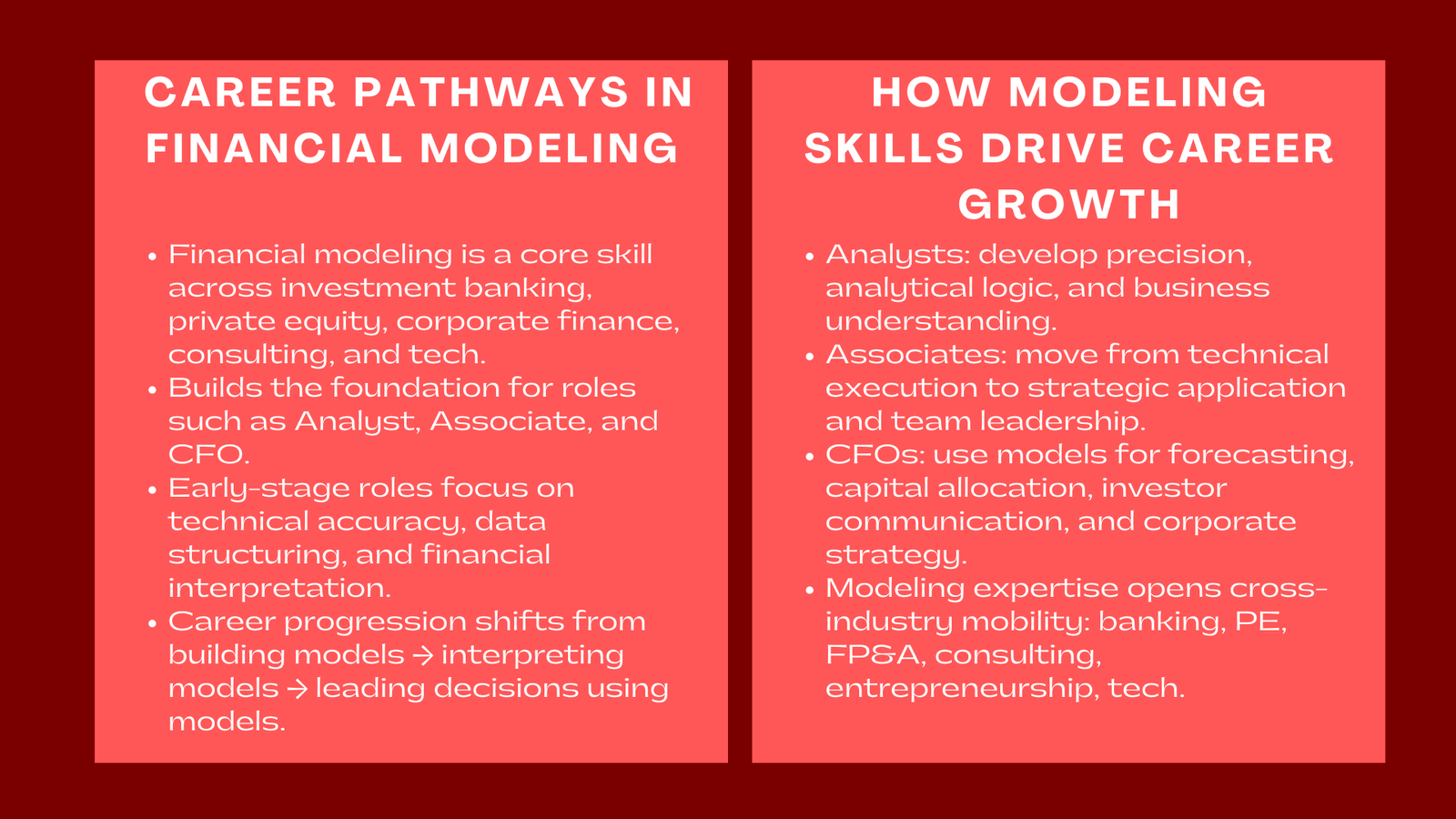
Financial modeling has become one of the most sought-after skills in the modern finance profession. It underpins decision-making across investment banking, private equity, corporate finance, consulting, and even technology sectors. The ability to build, interpret, and communicate financial models distinguishes high-performing professionals who can translate data into strategic insights. Beyond its technical utility, financial modeling defines career opportunities in financial modeling Singapore trajectories — shaping how analysts, associates, and senior executives evolve within the financial ecosystem.
For early-career professionals, modeling proficiency opens doors to analyst and associate positions in investment and corporate environments. As responsibilities grow, mastery of modeling transitions from a technical function to a strategic leadership competency — one that prepares professionals for roles such as Chief Financial Officer (CFO), where the synthesis of financial insight and executive judgment becomes critical.
This article explores the career pathways in financial modeling, examining how modeling skills evolve across roles, industries, and organizational hierarchies. It also highlights how professionals can leverage these capabilities to build long-term, fulfilling careers in finance and business leadership.
The Strategic Importance of Financial Modeling
A Universal Skill Across Financial Disciplines
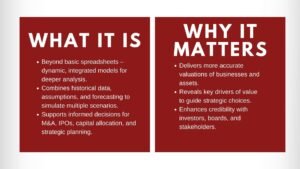
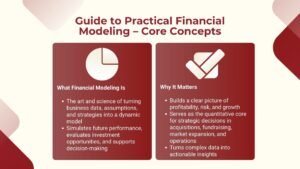
Financial modeling serves as the analytical foundation for nearly every major financial decision. From valuing a company to forecasting earnings, structuring a merger, or evaluating capital expenditures, modeling converts complex financial data into structured decision frameworks. In investment banking, it drives transaction valuation; in corporate finance, it supports strategic planning and resource allocation; and in private equity, it determines investment viability and exit strategies.
The universality of financial modeling skills for career growth in finance Singapore has transformed it into a professional language spoken across sectors. Regardless of industry or specialization, the ability to construct and interpret models reflects a professional’s capability to think quantitatively, reason logically, and communicate effectively with decision-makers.
Modeling as a Tool for Strategic Insight
Financial modeling is not merely a computational exercise; it is a decision-support mechanism. A model’s structure mirrors how a professional interprets a business — its value drivers, risk factors, and growth dynamics. This analytical lens enables individuals at every level, from analysts to CFOs, to move beyond descriptive reporting toward prescriptive decision-making.
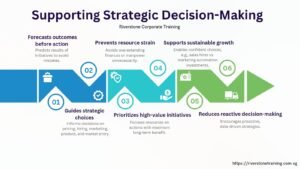
By simulating scenarios, testing assumptions, and quantifying risks, modeling empowers professionals to forecast outcomes before they occur. Those who can design such frameworks earn trust and authority, making financial modeling an enduring source of professional influence and career advancement.
The Analyst: Building the Foundation of Financial Expertise
Role Overview and Responsibilities
The analyst role represents the entry point into most financial modeling careers. Analysts are responsible for collecting data, building detailed financial models, and producing reports that support senior decision-makers. In investment banking, analysts construct valuation models, merger models, and leveraged buyout (LBO) analyses. In corporate finance or FP&A, they create budgets, forecasts, and scenario analyses to guide management decisions.
At this stage, modeling is highly technical. Analysts must translate financial statements into structured models, ensuring internal consistency across income statements, balance sheets, and cash flow statements. Accuracy, attention to detail, and logical clarity define success. Analysts who master the discipline early set a foundation for upward mobility.
Developing Core Competencies
Analysts develop three primary competencies: technical precision, analytical thinking, and financial interpretation. Technical precision refers to the ability to manipulate data efficiently using tools such as Excel, Python, or financial modeling software. Analytical thinking involves understanding relationships between variables and how business activities influence financial outcomes. Financial interpretation means converting model results into insights — explaining not only “what” the numbers show but “why” they matter.
Analysts who go beyond formula-building and demonstrate business understanding quickly distinguish themselves. They evolve from technical executors to analytical contributors, earning recognition and trust from senior colleagues.
Early Career Growth and Transition Opportunities
A strong modeling foundation allows analysts to transition across finance disciplines. Investment banking analysts may move into private equity, venture capital, or corporate development roles. FP&A analysts may progress into strategic finance, investor relations, or operations management. Because modeling skills are universally applicable, analysts who build robust, auditable models and communicate findings clearly can pivot toward whichever financial path aligns with their interests.
This early stage establishes professional habits — documentation, transparency, and analytical discipline — that will continue to serve them as they move into more strategic roles.
The Associate: From Technical Mastery to Strategic Application
Evolving Responsibilities and Leadership Transition
As professionals advance to the associate level, the focus shifts from pure model building to model interpretation and management. Associates oversee analysts, review models for accuracy, and synthesize outputs into presentations for clients or executives. They must ensure that assumptions are reasonable, logic is consistent, and results align with strategic goals.
Associates also begin to participate directly in deal execution or corporate decision-making. In investment banking, they coordinate due diligence and valuation discussions. In private equity, they evaluate investment opportunities and design financing structures. In corporate finance, they translate forecasts into strategic recommendations for department heads or boards.
Strategic Thinking Through Modeling
At this stage, associates must understand not only how to model but also how to think strategically through models. This means recognizing how changes in capital structure affect return on equity, how market dynamics influence revenue growth, or how macroeconomic factors alter valuation multiples. The model becomes a living instrument for testing strategic hypotheses.
Associates who develop this level of financial reasoning become indispensable contributors in high-level discussions. They are trusted not only for their numerical accuracy but for their ability to interpret and communicate strategic implications.
Mentorship and Communication Skills
Associates serve as a bridge between junior analysts and senior management. Their ability to guide modeling efforts, train new team members, and communicate complex results effectively determines team success. Clear communication — both written and verbal — becomes as important as technical ability.
Strong associates learn to tailor their explanations to different audiences: simplifying analysis for clients or executives while maintaining technical rigor for internal review. This balance of detail and clarity defines the hallmark of a professional prepared for leadership.
The CFO Pathway: Modeling as a Strategic Leadership Tool
The CFO’s Role in Financial Modeling
At the senior executive level, financial modeling transitions from an operational tool to a strategic instrument for decision-making and communication. Chief Financial Officers (CFOs) use models to guide corporate strategy, evaluate investment opportunities, and manage financial risks. They rely on modeling outputs to communicate performance expectations to boards, investors, and lenders.
While CFOs may no longer build models themselves, their deep understanding of modeling logic allows them to challenge assumptions, interpret scenarios, and make high-stakes financial decisions. A CFO’s credibility often depends on their ability to synthesize complex modeling outputs into concise strategic insights.
Strategic Forecasting and Capital Management
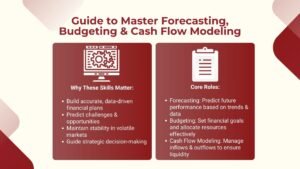
CFOs use modeling to steer corporate direction through long-term forecasting and capital management. They integrate budgeting, forecasting, and valuation frameworks into unified financial models that link operational metrics to strategic outcomes.
Through these models, CFOs evaluate capital allocation decisions — determining how much to invest in growth, how to structure debt, or when to return capital to shareholders. The capacity to test “what-if” scenarios empowers CFOs to anticipate risks and seize opportunities. In turbulent markets, this modeling-driven foresight becomes essential for corporate stability and growth.
Leadership, Governance, and Investor Confidence
At the highest level, financial modeling underpins governance and investor relations. Investors expect CFOs to justify strategic decisions through quantitative evidence. Models provide the foundation for earnings guidance, capital expenditure plans, and strategic disclosures.
CFOs who can communicate the logic and assumptions behind financial projections build investor confidence and strengthen corporate credibility. Their modeling fluency demonstrates not only analytical competence but also transparency and accountability — hallmarks of effective financial leadership.
Cross-Industry Career Pathways in Financial Modeling
Investment Banking and Advisory Roles
In investment banking, financial modeling forms the basis of transaction advisory and client service. Analysts and associates perform valuation, merger, and leveraged buyout modeling to assess deal feasibility and pricing. As professionals progress, they shift toward managing client relationships and leading deal execution, using modeling to support negotiations and strategic recommendations.
Those who demonstrate modeling excellence often transition into buy-side roles such as private equity or hedge funds, where modeling becomes an even more central component of investment decision-making.
Corporate Finance and FP&A Careers
In corporate environments, modeling drives financial planning, resource allocation, and performance management. FP&A professionals use models to forecast revenues, expenses, and cash flows, supporting executive decisions and board reporting. As they advance, their roles expand from data analysis to strategic advising, often culminating in CFO or Director of Finance positions.
These professionals combine technical modeling expertise with operational understanding, making them key contributors to long-term corporate success.
Consulting, Entrepreneurship, and Technology
Beyond traditional finance, modeling skills are increasingly valuable in consulting, entrepreneurship, and technology. Consultants use models to evaluate strategic initiatives and business transformations, while entrepreneurs rely on modeling to assess funding requirements and scalability.
In the technology sector, data-driven financial modeling supports product pricing, market entry analysis, and investment in innovation. Professionals with strong modeling skills can thus navigate diverse industries while maintaining a consistent analytical core.
Developing a Career Strategy Through Financial Modeling
Continuous Learning and Specialization
Career growth in financial modeling depends on continuous learning. Professionals must stay current with evolving valuation techniques, analytical tools, and industry trends. Specialization in areas such as project finance, M&A modeling, or advanced data analytics enhances professional differentiation, especially for those pursuing financial modeling Singapore for career advancement.
Equally important is developing proficiency in new technologies. Modern finance increasingly integrates business intelligence tools, automation, and artificial intelligence with traditional modeling frameworks. Professionals who adapt to these changes remain competitive and forward-looking.
Building Strategic and Interpersonal Competence
While technical expertise is critical, long-term success requires strategic awareness and interpersonal skill. Professionals who understand the business context behind their models and communicate insights effectively earn credibility as trusted advisors. They become the bridge between data and decision — a role that remains vital at every career level.
Networking, mentorship, and cross-functional exposure also accelerate career development. Collaborating across finance, operations, and strategy builds a holistic perspective that strengthens both modeling acumen and leadership readiness.
From Technical Mastery to Strategic Leadership
Ultimately, financial modeling provides a pathway from technical mastery to strategic leadership. Early-career professionals develop analytical precision; mid-level professionals refine strategic interpretation; and senior executives apply modeling to shape organizational vision. This progression mirrors the evolution of a financial career — from detail-oriented analysis to value-oriented leadership.
Those who understand how to align modeling with business objectives transition naturally from building models to leading organizations that rely on them.
Conclusion
Financial modeling represents more than a technical skill — it is a career-defining capability that connects analysis to action, data to decision, and numbers to strategy. For analysts, it provides the foundation of financial understanding and credibility. For associates, it becomes a tool for synthesis, leadership, and communication. For CFOs, it transforms into a strategic framework for steering organizational growth and investor confidence.
The journey from analyst to CFO reflects a continuous deepening of both technical and strategic capacities. Each stage requires greater judgment, communication, and foresight — qualities cultivated through years of modeling experience.
In a world where financial acumen and data-driven thinking are increasingly vital, mastering financial modeling is not just about building spreadsheets; it is about building careers. Those who can interpret and communicate financial realities with precision and insight will continue to lead in shaping the future of global business and finance.